Marketing Management

Marketing Mix of Allianz – Allianz Marketing Mix [Detailed]

In this article, we will discuss the Marketing Mix of Allianz. Allianz SE is a multinational company involved in insurance and asset management business. It is among the top companies in the world. It is ranked as the largest financial service company according to Forbes Magazine.
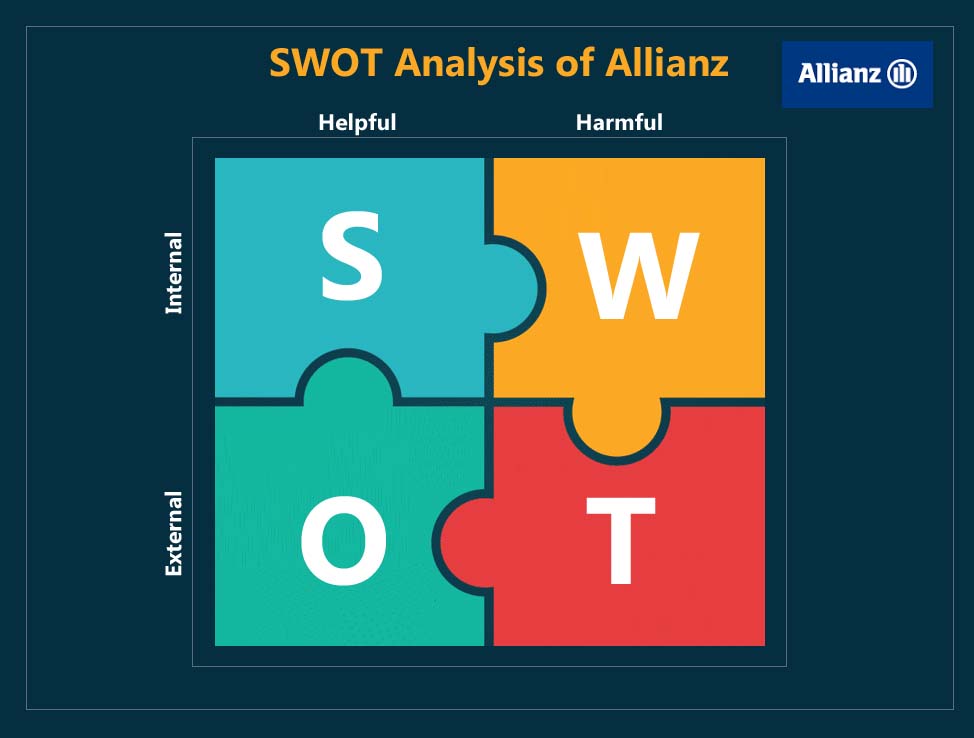
swot analysis of Allianz

Products in the Marketing Mix of Allianz

Unit Linked Plans, Retirement Plans, Term Life Insurance, Child Insurance, Health Insurance, etc. Allianz is having good insurance policies. Claim Settlement of Allianz is also good. Some of the products and services offered by Allianz are :

  • Unit linked Policy [ULIP]
  • Asset Management Services
  • Banking and Finance Services
  • Home Insurance and Shop Insurance
  • Accidental insurance
  • Health insurance
  • Life insurance
  • Child plans
  • Pension Plans
  • Term Insurance

Place in the Marketing Mix of Allianz

Allianz has offices in more than 70 countries around the world. They have selected partners in other locations, enabling them to serve clients in more than 160 countries around the world. In India, Allianz has worked with Bajaj Finserv Limited to bring its international services and expertise to the country. Bajaj Allianz has a national network of 200 cities spread throughout the country from Surat to Siliguri and Kashmir to Thiruvananthapuram.

Its headquarters are in Pune, Maharashtra, and all the offices are interconnected.

Since it has a good network of offices around the world, its customers can easily and conveniently access its services.
swot analysis of allianz - 1

Price in the Marketing Mix of Allianz

Premium is very competitive and the charges in Unit Linked Insurance Plans are also good. Term Insurance plans premium is also good. By offering value for money, Allianz Life Insurance was a trend-setter in the insurance industry. The organization is committed to provide its customers with the best and highest value products at minimum prices. It has kept the premium insurance policy prices at normal level so that large number of people can take advantage of its insurance plans. Allianz is fairly faces strong competition from other existing well established insurance companies. To build its own loyal customer base, it has introduced fair pricing strategies and has kept its premium rate affordable and pocket-friendly. The company has introduced penetration strategy to penetrate expanding insurance market.

Promotion in the Marketing Mix of Allianz

The publicity and advertisement plan of the Allianz corporate campaign is as follows:

Allianz seeks to attract new clients and maintain existing ones by delivering newer products and services, thus separating itself from its rivals.Some of the ways of Promotions are:

  • Sponsorships: Sponsorship plays a significant part in the advertising blend. Previously, Allianz called the stadium in Munich through a Facebook contest in which its global customers (approximately 80 million) were offered choices to choose from and the most proposed alternative was selected as the stadium name. That is how Allianz has served its customers. The company is also sponsoring other international sports platforms, such as Paralympics Games, Formula One, and Golf.
  • Brand Ambassadors: Allianz has established an arrangement with the musician Lang, who is employed as his brand ambassador. Allianz uses national and international sponsorships to form communities according to their interests and passions. Allianz believes that people play an important role in Allianz ‘s business in encouraging individuals to make progress in their lives. That’s why Allianz is heavily involved in sponsoring sporting events around the globe.
  • Advertisements: Allianz engages in TV commercials to communicate its latest offerings to its target audience. Ads are also seen on the News, Information and Sports networks. Digital Media and Print Advertising are also used in newspapers.
  • Mobile App: Allianz launched a mobile app that was an instant tax calculator that allowed users to calculate their tax liability. There was a 360-degree advertisement to market the app.
  • The company is also using social media platforms like Facebook, Twitter, Instagram to promote its business.
  • The company is also using Advertising Networks like Adsense and Meda.net and other video advertising platforms.

People in the Marketing Mix of Allianz

Allianz focuses a great deal on the people it interacts with, whether employees or customers. Employees play a key role in the services industry. Over 142,000 employees working with Allianz and providing services to 85 million clients worldwide. Employees have diverse backgrounds in order to provide services to customers with over 100 different job profiles. Workplace engagement is received on a daily basis to boost employee retention, commitment, activism, and pride. Allianz employees propose the best policies on the client’s needs, which also strengthens customer satisfaction.

Process in the Marketing Mix of Allianz

User requests should be answered easily. Allianz frees all procedures without any delay and limited documentation and formalities. The users are connected with the recently introduced offerings through its smartphone app. Both systems are streamlined and thus better support the customer.

Physical Evidence in the Marketing Mix of Allianz

Allianz maintains branches in big cities and towns around the country at accessible sites. The workplace setting with a friendly climate is given particular importance. The counters are placed in such a way as to provide prompt services without delay. The offices have a sleek look and sound with waiting rooms with sofas and newspapers. This covers the whole product spectrum of Allianz.

If you like This Article Please Like our Facebook Page PROJECTS4MBA

Cite This Work

Referencing Style to cite this article:
[citationic]

Marketing Mix of Allianz – Allianz Marketing Mix [Detailed] Read More »
Marketing Mix of HDFC Life Insurance [step by step Guide]

This article focuses on the Marketing Mix of HDFC Life Insurance. HDFC Life Insurance is a venture between HDFC Ltd. and Standard Life. HDFC Ltd has a stake of 51.4% and Standard Life has a stake of 12.3% and rest of the stake. Remaining equity are hold by public. HDFC Life Insurance Limited has started its operations in the year 2000. HDFC Life Insurance Limited is the market leader in a Private Life Insurance company followed by SBI Life, and Bajaj Allianz. Some of the main competitors are :

  • SBI Life
  • Bajaj Allianz Life Insurance
  • HDFC Life Insurance
  • Religare Life Insurance
  • Sahara Life Insurance
  • Tata AIA Life Insurance

Product in the Market Mix of HDFC Life Insurance

HDFC Life Insurance has a customer-centric approach. The organization has long term savings and protection plans for different stages of life. The company has cost-effective products, good customer support, consistent growth in investments, and a fast claim settlement process.

Products of HDFC Life Insurance are:

Term Insurance Plans

  • HDFC Life Click 2 Protect Plus
  • HDFC Life Click 2 Protect 3D Plus Plan

Money Back Plan

  • HDFC Life Super Income Plan

Unit Linked Insurance Plans – ULIPs

  • HDFC Life Click 2 Wealth Plan
  • HDFC Life Classic One Plan
  • HDFC Life Sampoorn Nivesh
  • HDFC Life Click 2 Invest Plan Review
  • HDFC Life Capital Shield Plan
  • HDFC Life Pro Growth Plus Plan
  • HDFC Life Single Premium Pension Super Plan
  • HDFC Life Pro Growth Maximiser Plan
  • HDFC Life Pro Growth Flexi Plan
  • HDFC Life Smart Woman Plan
  • HDFC SL Pro Growth Super II
  • HDFC Life Young Star Super Premium
  • HDFC SL Crest

Whole Life Plan

  • HDFC Sampoorn Samridhi Plus

Endowment Plans

  • HDFC Life Pragati Plan
  • HDFC Life Super Savings Plan
  • HDFC Life Uday
  • HDFC Life Classicassure Plus Plan
  • HDFC Life Sanchay

Child Insurance Plan

  • HDFC Life YoungStar Udaan

Pension Plans

  • HDFC Life Assured Pension Plan
  • HDFC Life Guaranteed Pension Plan
  • HDFC Life Click 2 Retire Plan
  • HDFC Life New Immediate Annuity Plan
  • HDFC Life Personal Pension Plus Plan

Health Plans

  • HDFC Life Easy Health Plan
  • HDFC Life Cancer Care
  • HDFC Life Cardiac Care Plan
  • HDFC Life Click 2 Protect Health

Place in the Market Mix of HDFC Life Insurance

HDFC Life Insurance offers its coverage in every part of India and has a H.Q. in Mumbai, Maharashtra. It has a wide distribution chain that allows its consumers all over the world to supply their services. This covers insurance agent services, online insurance websites, insurance agents, direct networks and banking partner services. HDFC Life Insurance’s multichannel network has spread to almost nine hundred and eighty cities and towns in India, and is managed through an estimated three hundred and ninety-eight branches. The staff comprises two lakh financial consultants to effectively meet growing customer demand by providing individual attention. HDFC Life Insurance has formed a liaison bureau in Dubai.

HDFC Life has multiple channels for selling its policies. HDFC LIFE is selling its policies through its branches. Insurance Advisors are also recruited by the company. Bancassurance is also a channel for selling its policies. HDFC Life has branches all over the country to market its products. Marketing Executives are trained to explain the features and benefits of HDFC Life Insurance. HDFC LIFE is also selling its policies through Online Channel. HDFC Life has a simple claim settlement process.

Price in the Market Mix of HDFC Life Insurance

By offering value for money, HDFC Life Insurance was a trend-setter in the insurance industry. The organization is committed to provide its customers with the best and highest value products at minimum prices. It has kept the premium insurance policy prices at normal level so that large number of people can take advantage of its insurance plans. HDFC is fairly faces strong competition from other existing well established insurance companies. To build its own loyal customer base, it has introduced fair pricing strategies and has kept its premium rate affordable and pocket-friendly. The company has introduced penetration strategy to penetrate India ‘s expanding insurance market.

Promotions in the Market Mix of HDFC Life Insurance

HDFC Life Insurance differentiates itself as one of India’s most trusted brands. It has put its emphasis on CSR activities to improve the social conditions. It was the recipient of several awards for the various plans. Sar Utha Ke Jiyo is one of its most famous taglines, and has generated high visibility among consumers. HDFC Life has taken on several promotional activities to create positive awareness of the brand. Successful advertising campaigns have been launched on radio and several television channels through electrical media. Its advertisements appear in magazines, hoardings, and newspapers. It has an official website that provides interested parties with the related information.

HDFC Life is taking every possible measure to promote its policies. HDFC Life Insurance is using modern techniques for promoting its products and services. For Online advertisements the company is using Google Ad Network and other Ad Networks. The company is using Facebook Marketing, Whatsapp Marketing, and other online Marketing platforms for its promotion. HDFC Life is also advertising its products on Television, Print Media, and Magazines. It is also using Hoardings for promoting its products throughout the country. It is also promoting its products on various Social Media Platforms. These aggressive techniques are developing a good image among the customers of the company.

Insurance Advisors and Insurance executives are also promoting its insurance policies to the customers. HDFC is having a good customer centric approach and try to maintain good customer relations to retain customers.

If you like This Article Please Like our Facebook Page PROJECTS4MBA

Cite This Work

Referencing Style to cite this article:
[citationic]

Marketing Mix of HDFC Life Insurance [step by step Guide] Read More »

SWOT Analysis of Cafe Coffee Day (CCD) [step by step SWOT]

This SWOT Analysis of Cafe Coffee Day (CCD) focuses on Internal and External Factors. Internal factors are strengths and weakness and external factors are opportunities and threats. This SWOT Analysis of Cafe Coffee Day (CCD) analyzes strengths, weaknesses, opportunities, and threats of Cafe Coffee Day (CCD).

Let’s discuss SWOT Analysis of Cafe Coffee Day (CCD)

Strengths in the SWOT Analysis of Cafe Coffee Day (CCD)

  • Products of incredibly high quality and flavor – the coffee menu of Cafe Coffee Day is well-known and customers just love it. Besides this, Cafe Coffee Day has already launched some sandwiches and little bits that are a huge hit with people as well.
  • It’s a youth-oriented brand, catering to the millennial – it has a tremendous opportunity because 40% of the people joining the CCD are young.
  • It produces/grows the coffee it serves while reducing the cost – this is a crucial point for Coffee Day, and backward integration saves a lot of money.
  • The USP is inexpensive and convenience – you can stay in a Cafe for the entire day, and no one can ask you to leave. This warmth is the biggest USP of Cafe Coffee Day. Around the same time, the menu is inexpensive enough that people come to CCD from time to time and have a nice time.
swot analysis of cafe coffee day

Weaknesses in the SWOT Analysis of Cafe Coffee Day (CCD)

  • Losing its charm – The brand has lost its charm at the outset, mainly because it does not invest in promotions and Starbucks’ entry, as well as various local competitions, has affected the image of the brand.
  • There’s no power to sustain brand loyalty – it’s been a local coffee shop, but it’s not something people remain loyal.
  • Poor Ambiance and Decor-Many day coffee shops have a very poor atmosphere and decor. The flagship stores are beautifully run and push the reputation of the brand. Yet shops are still available with bad interiors. Anything the retailer should take care of since it’s a type of a franchise.
  • Many CCD stores are incurring losses due to incorrect site selection – this has hurt CCD over time as many CCD brand stores have been opened on the wrong site and not on the main roads. As a retail establishment, this also affects turnover and brand name.

Opportunities in the SWOT Analysis of Cafe Coffee Day (CCD)

  • Introduction of new items on the menu: Introducing more items and more offerings on the menu may increase the profits of CCD
  • Good interiors – Cafe Coffee day needs to uphold consistency in the interiors of all the outlets it provides. Once you head out of the city, you ‘re going to find the interiors to be much more shabby. It is a poor indicator of the price and durability of the brand.
  • Coffee is one of the fastest growing industries in Asia and recognition is rising with more and more foreign players joining the market.
  • More people like to visit CCD for informal meetings. Cafe Coffee Day can be advertised as a meeting point as well as a casual meeting point.
  • CCD has gone internationally and is planning to attract many new international markets, thus gaining international recognition.

Threats in the SWOT Analysis of Cafe Coffee Day (CCD)

  • Rivalry – Coffee Day has a lot of competition, particularly with other coffee Cafes like Barista, Mochas, Starbucks, McDonald’s, and others.
  • Indirect competition – Other hukka parlors such as Sheshas, Peshawar, Koylas, U-Turn also attract a lot of attention and prefer the younger generation to hang around, which in turn attracts the market captivated by CCD.
  • Government Regulations can be a major threat to Cafe Coffee Day.
  • Situations like COVID-19 can be a major threat to the earnings of the company.

If you like This Article Please Like our Facebook Page PROJECTS4MBA

Cite This Work

Referencing Style to cite this article:
[citationic]

SWOT Analysis of Cafe Coffee Day (CCD) [step by step SWOT] Read More »

SWOT Analysis of McDonalds [Explained]

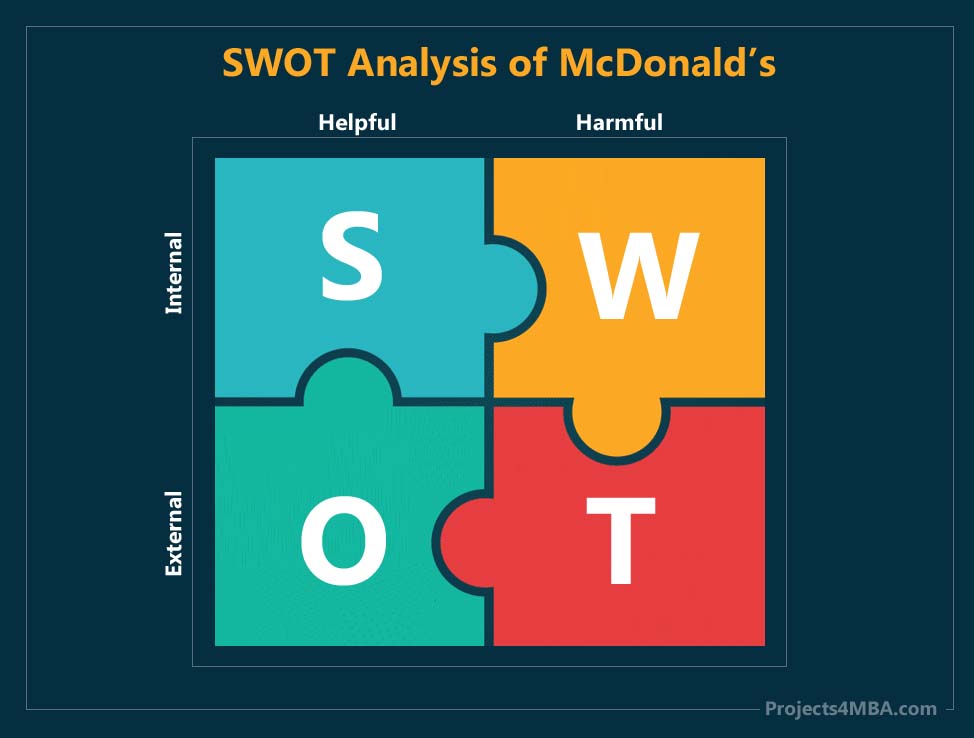
This McDonald’s SWOT Analysis – SWOT Analysis of McDonalds focuses on Internal and External Factors. Internal factors are strengths and weakness and external factors are opportunities and threats. This SWOT Analysis of McDonald’s analyzes the strength, weaknesses, opportunities, and threats of McDonald’s.

McDonalds is a leading player in fast food business. McDonalds is an American company founded in the year 1940 by Maurice and Richard.

McDonald’s was established in Bernardino, California. And within 8 years the store was turned into a fast-food chain. McDonald’s was acquired by Ray Korc and in the year 1955, he opened first franchise at Des Plaines, Illinois, and converted McDonald’s into a company.

McDonald’s is among the top 10 international fast-food chains with 37855 restaurants worldwide, including India, Canada, Australia, France, U.K., Poland, Germany, Japan, Netherlands, Italy, China,  Russia, Sweden, Spain, etc.

Let’s do the SWOT Analysis of McDonald’s SWOT Analysis/SWOT Matrix. This article focuses on how McDonald’s takes the strategic advantage of its brand identity.

swot analysis of mcdonalds - 2

Strength in the McDonalds SWOT Analysis – SWOT Analysis of McDonalds

The following are the most influential facets of McDonald’s, which have assured sustainability, growth and ubiquitous brand identity of the company. 

  • Brand Popularity: McDonald’s is the most popular brand in the world. Despite an unparalleled market image, the company dominates the restaurant business irrespective of the tough competition. 
  • Good Taste: McDonald’s Potato French fries are popular because of its taste.  McDonald’s French fries are great tasting potatoes, says the consumer report. 
  • McDonald’s has developed Real Estate Empire: Aside from selling burgers and fries, McDonald’s has developed Real Estate Empire. McDonald’s has a fast food retail chain across the globe. McDonald’s is expanding its roots across countries. McDonald’s has around 37855 fast-food chains across 120 countries. McDonald’s franchise is operating somewhat differently. McDonald’s not only offered its brand name, products, materials, franchisees’ operations but also makes money from rent collected.
  • Technological Advancement: McDonald’s fulfills its vision of “Digital Engagement” through technological advancements. Initiatives such as the introduction of Website and Mobile Applications gives an added income to McDonald’s.
  • Analytics and Information Collection: Company is collecting data and analyze the demands of the customers to generate attractive offers.
  • Market Recognition: McDonald’s holds the prestige of becoming the world’s most popular fast-food brand.
  • Believes in Safety and Health Concerns of Customers: You can debate the flavor and overall consumer service, but McDonald’s consistency level has always been a selling point. The Organization enforces full product health and consistency procedures when sourcing products from third-party intermediaries.  McDonald’s has also started to ban the use of high-value human antibiotics. The World Health Organization (WHO) has described human medicine as the “top priority critically essential antimicrobials” (HPCIA) in its global chicken supply since 2018.  A variety of public health and community advocates are also appreciative of this strategy because it is a successful attempt to avoid harmful bugs. 
  • Leading fast-service restaurant: It is a fast-service restaurant chain in the World. McDonald’s services are fast and error-free. This quality has set the standards for the company in a fast-food market.
  • Attractive offers and New Ways of Publicity: McDonald’s Combos are famous for their value and taste. McDonald’s is using modern ways of promotion. Promotion includes Promotions through Google Ads, Instagram Promotions, Facebook Promotions, Social Media, and Television.
  • McDonald’s Fast Food is loved by a youngster: Youngsters love to visit McDonald’s to have their meals.
swot analysis of mcdonalds

Weakness in the McDonalds SWOT Analysis – SWOT Analysis of McDonalds

Here are some of the weakness of McDonald’s fast food retail chain.

  • Franchise Model of Business: McDonald’s is the perfect example of a multinational franchise model. Risks of loss, disappointment with the consumer, mismanagement, and poor sales growth. The organization is heavily dependent on franchises that run individually and thus have no influence on their day-to-day activities, so it directly affects the brand. 
  • Supply Chain: McDonald’s fast-food chain also faces challenges due to delays in the supply chain. This also restricts the supply of goods that are essential to operations. As a result, as a franchisee faces these interruptions, operating costs escalate, resulting in reduced sales and decreased productivity. 
  • Problems related to Employees: Owing to recent employee-right protests around the world and expanded pay caps, many companies have encountered critical discontent from workers.  McDonald’s also faced intense criticism from its employees. The employees went on a series of rallies and strikes demanding that their minimum pay be increased on $15 an hour, costing the company’s reputation loss. 
  • Lost Appeal in Breakfast Segment: Same breakfast menu creates a hurdle in the path of McDonald’s they must change their menu to generate more revenue. 
  • CEO was shot  In November 2019, McDonald’s CEO, Steve Easterbrook, was terminated following a romantic relationship with the employee. It has broken corporate policies. The board also reported that Steve had “demonstrated bad judgment.” 

Opportunities in the McDonalds SWOT Analysis – SWOT Analysis of McDonalds

The following opportunity segment for McDonald’s outlines the developing prospects for expansion. This will help the organization boost its financial efficiency, organizational structure , strategic development and other facets. 

  • New Pricing Opportunity: McDonald’s unveiled the new “$1, $2, $3” menu and “2 for $5 Mix and Match Deal” for its customers. The menu has resulted in improved sales. 
  • Innovative Menu: McDonald’s will make sure to add fresh, creative items to their menu and help people prefer them instead of fresh fast-food chains. Introducing more such products according to local environments and communities will help McDonald’s retain their appeal for a longer period of time. 
  • Global Expansion: McDonald’s reign over the US, but it is also battled on the world market. Nevertheless, the organization has a strong opportunity to pursue its worldwide growth by relying more on overseas markets than on the various states of -America. 
  • Building Good Brand Identity: McDonald’s is maintaining its offensive, nutritious and personalized offers. These innovations have started to demonstrate results, with strong comparative sales contributing to an improvement in earnings. McDonald’s is not compromising its quality and rates. McDonald’s has created a good brand identity. 
  • App order and Delivery: McDonald’s has launched a relationship with Zomato and Swiggy to deliver food. Such mobile order and distribution programs allow McDonald’s to fulfill the ever-changing demands of its customers. 
swot analysis of mcdonalds - 1

Threats in the McDonalds SWOT Analysis – SWOT Analysis of McDonalds

The challenges or threats factor is related to a trend that prohibits the organization from taking full advantage of the strengths. So, these are the only challenges that McDonald’s faces.

  • Infrastructure Innovation Programs: While the creative developments introduced by McDonald’s have an optimistic future, innovation in technology is always risky. McDonald’s ROI decreases because of the adoption of New Technology and Innovative Infrastructure. 
  • Tough competition from rivals: McDonald’s is getting tough competition from Burger King, Wendy’s, and Chick-fil-A.
  • Cultural Risk: McDonald’s has to face numerous cultural challenges in various areas of the world, creating harm to the brand’s reputation.  It was also a very challenging job for McDonald to operate with the franchise model. McDonald’s has also faced problems in Muslim Countries. Controversies for not using Halaal food has deteriorated the image of the brand.
  • New Era Fast Food Phenomenon: Due to McDonald’s conventional menu and taste restaurant chains such as Wendy’s and shake shack take full advantage of their mostly tried-and-tested menu and recipes for choice.
  • Constant care for the climate: Like every other fast food company, McDonald’s is under extreme pressure to change its activities and reduce waste, which creates environmental contamination.
  • Changing Governmental Policies: Government policies related to FDI may affect the business of McDonald’s. Growing ecological issues call for McDonald’s to take steps in this regard and set a precedent for other food sources, but this is not that easy.
  • The use of Plastic is also banned in some regions hence McDonald’s has started the use of Paper Straw.

Conclusion

McDonald’s is one of the leading food companies of all time, creating tremendous innovation and customer engagement. However, due to the continued history of the company, it keeps a close eye on the things that can create problems.

In this McDonald’s SWOT analysis, we outlined each of the strengths, limitations, prospects and risks that McDonald’s faces on the market.

If you like This Article Please Like our Facebook Page PROJECTS4MBA

Cite This Work

Referencing Style to cite this article:
[citationic]

SWOT Analysis of McDonalds [Explained] Read More »

SWOT Analysis of Honda Motors [Step by Step SWOT]

Honda Motors is a company that has been admired for the excellent vehicles it has provided us with since ages. Honda is a smart player on the market and is considered to be one step ahead of the market and hence the company has never suffered in its tenure for decades.

Lets Discuss the SWOT Analysis of Honda Motors.

swot analysis of honda motors

Strengths in the SWOT Analysis of Honda Motors – Honda SWOT Analysis

Largest manufacturer of motorcycles – There are many feathers in Honda motor cap but one of its greatest benefits is that it is the world’s largest producer of motorcycles. It has a largest share of the motorcycle market.

  • The largest producer of internal combustion engines – Including motorcycles, Honda motors also have a major presence on the market for combustion engines used for aircraft, jet skis, yachts, or other heavy engine use.
  • Eight largest car makers – Honda Motors is now the eight largest automotive producers in addition to being the world’s number one automobile manufacturer. It has a solid, localized portfolio of products.
  • Great R&D – One of the reasons Honda has managed to reach such heights is due to its emphasis on R&D and its R&D workforce. So Honda still comes up with sleek and innovative designs that are a success on the market.
  • High-tech products – Because Honda has high-tech products, the entry barriers are high and, hence, the brand has not been beaten in the last few years. When you combine Honda ‘s complete product portfolio, you’ll understand how technically the firm is solid.
  • Over the years, brand value – Honda was able to offer hit goods after reaching the goods. The Honda Accord is one of the most loved cars and so is the Honda CRV. In motorcycles, there are many highly engineered items that put Honda well ahead in its brand image than a lot of its rivals.
  • Large employee base: Honda has given employment to 215,638 people. They are the real asset of the company.
  • Product portfolio-Honda ‘s product portfolio is massive. It has at least 100 types of cars and other automobiles, 100 types of bikes and scooters, it has power equipment such as generators, it manufactures high-quality engines, it has its own helicopters, mountain bikes, and all-terrain vehicles. Which also looks into hybrid and renewable-powered vehicles? As you can see, all of these products are technologically advanced and have their own brand value, coming from Honda’s building.
  • Market share – As can be seen from the above points, Honda has a large market share of most of the goods it produces, owing to its manufacturing advantage.
  • Good Engine Quality of Vehicles.

Weakness in the SWOT Analysis of Honda Motors – Honda SWOT Analysis

  • High Manufacturing Costs– Obviously, with a strong R&D budget and state-of-the-art technology, commodity costs are high and end-customer prices are often high. It may be Honda’s vulnerability but it has to have its vulnerability because by reducing prices it can not reduce its brand value.
  • Upper Middle Class are Target Customers – A common criticism for Honda cars is that cars are only for the upper-middle class and Honda wants more car portfolio for the lower middle class already targeted by other car manufacturers such as Hyundai and Maruti.
  • Indian hero and honda separation – Honda engines suffered badly, at least in India, when Hero and Honda split. Honda has had to replan her involvement in India as a result.

Opportunities in the SWOT Analysis of Honda Motors – Honda SWOT Analysis

  • Electric and alternative fuel vehicles – This section is oriented towards the future of the automobile industry where people will be seeking the use of renewable energy as fuel such as petrol and diesel and CNG have their limits.
  • Increasing vehicles – Growing the number of cars around the world. Most of the reasons for this are the rise in individual buying power, another is that owning a motorcycle or a car now is a social standard. Consumption is now at an all-time peak.
  • Expansion in developed countries – Due to increased buying power and easy car loads provided by banks, automobile purchases are growing, especially in developing countries. Honda needs to take full advantage of this upsurge in demand and rapidly seize the market.
  • Market expansion – two strategies widely employed by car producers are introducing more products to the inventory and creating more models to expand the product line. A lot of considerations need to be performed before a new concept is introduced. However in a competitive market , product expansion is the secret to rising.

Threats in the SWOT Analysis of Honda Motors – Honda SWOT Analysis

  • Competition – Competition by local and regional or national players in each of the countries in which it is present dent Honda ‘s revenues.
  • Fuel prices – While people now have more money to purchase vehicles, increasing fuel costs are worrying us and are one of the reasons why many people are still reluctant to buy vehicles, since later on the fuel costs charged are more than the cars.
  • Rising transportation and other costs – Transportation as well as production and labour costs are one of the things that plagues all car manufacturers. These costs are still on the rise with inflation, and are always a problem.

If you like This Article Please Like our Facebook Page PROJECTS4MBA

Cite This Work

Referencing Style to cite this article:
[citationic]

SWOT Analysis of Honda Motors [Step by Step SWOT] Read More »

SWOT Analysis of Tide [Detailed SWOT]

The purpose of this comprehensive SWOT analysis of Tide is to analyze Tide’s internal and external factors. It’s about looking at the Tide’s strengths and weaknesses. This article also seeks to discuss the opportunities that Tide should grab and the possible threats that it should keep an eye on.

Tide is a powdered detergent that is manufactured by (P&G) Procter & Gamble. Tide Detergent was launched in the year 1946. Tide was the first detergent to be sold nationwide. The P&G has 6 detergent powders range and one liquid detergent range under Tide brand name.

Lets discuss SWOT Analysis of P&G

swot analysis of tide

Strengths in the SWOT Analysis of Tide – Tide SWOT Analysis

  • The flagship brand P&G – Tide celebrates the luxury treatment of being the flagship company of P&G. P&G also enhances the brand in order to build itself in the minds of consumers.
  • High-quality detergent at a lower price – Tide is playing on the USP to offer a higher quality product at a lower price and the company has so far been successful in achieving its objective. Customers are pleased with the quality of the goods and the costs are comparatively cheaper than those of the traditional rivals.
  • Current logistics and sales networks of P&G have been tremendous support – through the years, P&G has established good delivery and sales networks, and Tide profits tremendously from maintaining the same network without needing to spend any time in manufacturing and procurement activities.
  • Leading market share – Tide has gained from one of the largest brands of detergents, making them an additional bonus in exploring and innovating new goods to further boost their market position.
  • Strong emphasis on the value of whiteness – Both of Tide’s ads expresses the whiteness idea that they have been able to maintain effectively. That has also allowed them to concentrate on the USP that people wanted.
  • Solid brand recognition and awareness – Tide has become a household name and needs no introduction. They have been successful in targeting the company to the right audience, which has allowed Tide to retain high brand awareness on the market.
  • Tide is broadly distributed in all countries – the presence of the product in both rural, semi-urban, and industrial regional areas allows it the preference of every commodity that continues to keep consumers faithful to the brand.
swot analysis of tide - 2

Weaknesses in the SWOT Analysis of Tide – Tide SWOT Analysis

  • Old major rivals – The rivalry is massive and among the large corporations of the world, which is why Tide can not cause such big-name players to sacrifice their competitiveness in the market.
  • Similar or alternative goods are sold locally at much cheaper prices – as Tide sells itself as a low-quality detergent and more high-cost detergents are sold on the local market. This low price approach also serves as a negative influence on the company.
  • The industry is already established – the demand for detergents is now established and consumers want businesses to come up with something different. In order to offer this little difference, the player will often be totally removed from a competitive market like this one.

Opportunities in the SWOT Analysis of Tide – Tide SWOT Analysis

  • Introducing new products with advanced technologies and creativity – this is what our consumers are searching for and with mainstream goods such as detergents. There’s something Tide can explore in this place.
  • Rural markets have a strong opportunity – rural consumers are changing to use these new detergent goods at a very fast rate. This is a chance for a company like Tide to make good use of this chance.
  • Can Tide find a niche consumer audience on its own – any commodity is priced on the USP and for Tide, it is white at a lower price. It would be fascinating to see how they could discover and find for themselves a niche market that could establish a monopoly for them.
  • Shifting people’s habits – this is also an advantage. Put the best analysts in there to find out what this group needs and plan it. That will only happen if an organization will consider and respond effectively to the can needs of customers.
  • Seek new markets – While Tide is still present in many countries of the world, spreading deeper into new geographies is rarely a bad move, given that it is carried out with due care.

Threats in the SWOT Analysis of Tide – Tide SWOT Analysis

  • Imitation products – It is very simple for detergents to market fake items with identical names and labeling for a drug like detergent.
  • Market wars with rivals – Because competitors in the industry are all major corporations, often price wars prove lethal to one or the other.
  • Rival Ambush Marketing – Many businesses also use ambush marketing to tarnish the reputation of another company with such consumer goods. It is critical for a brand like Tide to always be at the forefront of these threats.
  • Changes in tax policies – Items like this, where a company battles for only the slightest advantage, a shift in tax policy will prove to be a big challenge.
  • Is the drug safe – the detergent is a substance where a lot of additives are used in the manufacturing of the product. In this situation, Tide will guarantee that, by all means, they comply with all the laws required to ensure that they are safe and environmentally sustainable.
  • Government Policies against Surfactants and chemicals can be a major threat.

If you like This Article Please Like our Facebook Page PROJECTS4MBA

Cite This Work

Referencing Style to cite this article:
[citationic]

SWOT Analysis of Tide [Detailed SWOT] Read More »

SWOT Analysis of Peter England [step by step SWOT]

SWOT Analysis of Peter England focuses on strengths, weaknesses, opportunities, and threats. SWOT Analysis of Peter England is done to analyze the Internal and External Factors. Internal Factors are Strength and Weakness and External Factors are Opportunities and Threats.

Peter England becomes the popular fashion brand that was established in Ireland in 1889. At the time of the Boer War, it was introduced to supply British troops with fine khaki trousers. Over the years, the company has also made its entrance into the Indian industry. During the year 2000, this company was purchased by the Aditya Birla Group and became India’s leading Menswear brand.

This company has been ranked among the top five most influential brands in the apparel industry for almost seven consecutive years. Holding a fashion trend in line, Peter England offers apparel that caters to every fashion opportunity in professional life. Having a deep interest in authenticity, this brand has become the most respected and responsible foreign brand to offer unmatched value to many young Indian people.

Having a strong presence in formal and casual wear for people, this company offers an creative range of specific clothing categories such as jeans, seasonal wear, linen, kurtas, accessories and more. The firm has its operating operations in around 150 cities and more than 700 brand outlets.

The company also offers comfortable workplace and casual wear across the numerous sub-brands of Peter England Products. The sub-brand Peter England Elite is the manufacturer of Luxury Formal Wear.

swot analysis of peter england

Strengths in the SWOT Analysis of Peter England – Peter England SWOT Analysis

  • Various types of apparel – Peter England offers apparel that is suitable for the workplace and people who want a sense of style in their clothes. It contains a number of lines, such as Peter England, the largest menswear brand, Peter England Components, which is casual office wear, and Peter England Elite, which is a luxury office wear.
  • Good Brand Image – The Peter England market is very successful and has a high brand recognition amongst the people.
  • Most Respected Clothing Company – the Peter England company has been named India’s most popular clothing brand. The brand’s clothing is a class in society.
  • Fashion Brand – Peter England offers luxury and international apparel to consumers and is available at all locations.
  • Occasion Driven Fashion – Peter England has attire that fits multiple events, such as formals, weddings, and parties.
  • Popular Menswear brand – Peter England is one of the biggest menswear companies and is expected to sell about six million garments per year.
  • Awards and Acclaim – Peter England also won several awards over the years, including Best Men’s Performing Brand Formal, Casual Wear and Consumer Satisfaction Summit in 2017, Best Marketing Campaign in 2015, and Most Respected Company in 2014.
  • Greater number of purchasing orders – Peter England has a large number of purchase orders, which is a big boost to the company.
  • Clothing is always up-to-date – Peter England’s clothing is always up-to-date with the new trendy trends to suit consumers ‘ needs.
  • Rewards Plan – Peter England has a creative and effective incentive system that helps regular buyers to receive points for any order.
  • Online Presence – The products of the brand are accessible online on their business website. This makes it convenient for shoppers to shop everywhere.
swot analysis of peter england - 1

Weaknesses in the SWOT Analysis of Peter England – Peter England SWOT Analysis

  • Small Global Footprint – has a restricted global reach relative to the other multinational company.
  • Powerful competition – The Peter England brand has a lot of rivals in both Indian and foreign markets. Such brands give most to consumers and thus there is a strong chance of a change of name.

Opportunities in the SWOT Analysis of Peter England – Peter England SWOT Analysis

  • Indian Wear Growth Potential – Peter England can expand its business to further grow Indian wear. This will encourage them to service customers who have been looking to wear Indian clothing for a variety of occasions.
  • Peter England to expand High Price clothings – Peter England will look to expand the product line to the higher price category of fashion or textiles.
  • Increase Global Footprint – The company should consider opportunities to extend its overseas market that will boost brand growth.
  • Mobile App – The company should have a smartphone app on both channels that can help the business expand as more and more customers continue to use their apps to buy.

More Structured Business Suite – The organization should create more formal business suites to increase brand awareness.

Threats in the SWOT Analysis of Peter England – Peter England SWOT Analysis

  • Emerging Brands – Many different products that have come into posing a significant challenge to the Peter England brand due to a common form of pricing.
  • Local labels with common trends – Several identical trends are available at cheap rates in many other local or ethnic products. It’s a major challenge for the company.
  • Imitation Product – Inexpensive imitation of the actual product is often a significant challenge to the company.
  • Socio-economic – The effect of the economic downturn is a significant threat to the company, as consumers may delay their transactions to cover increased costs.
  • Government policy – Shifting government policies will have a major effect on companies.

If you like This Article Please Like our Facebook Page PROJECTS4MBA

Cite This Work

Referencing Style to cite this article:
[citationic]

SWOT Analysis of Peter England [step by step SWOT] Read More »

SWOT Analysis of Air India – Air India SWOT Analysis

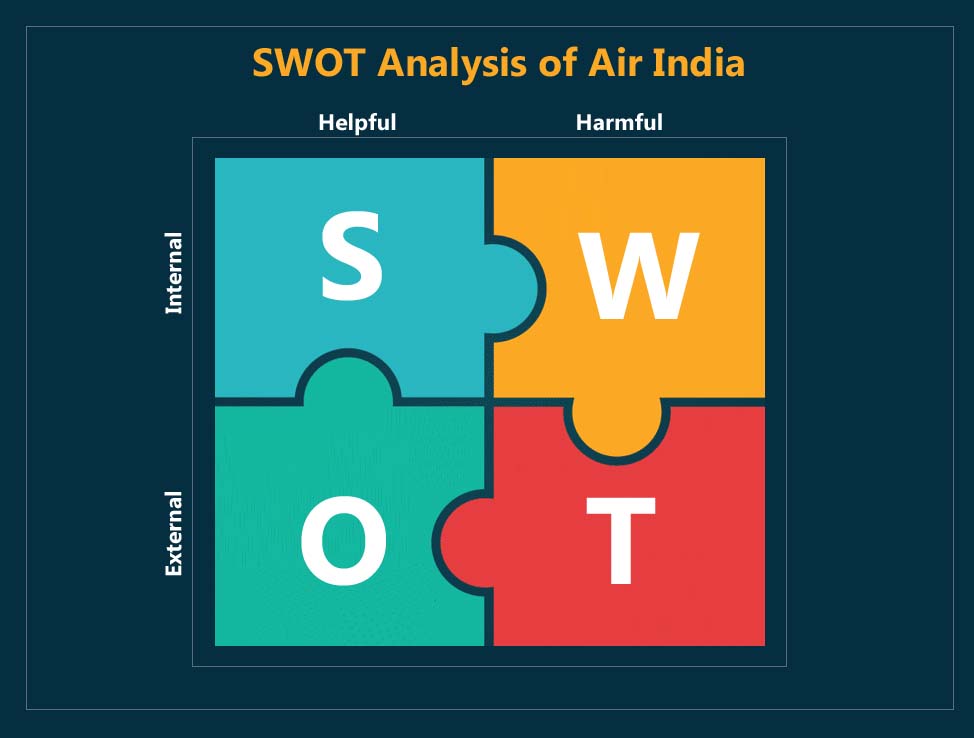
The purpose of this comprehensive SWOT analysis of Air India is to analyze Air India’s internal and external environments. It’s about looking at the airline’s strengths and weaknesses. This also seeks to discuss the possibilities that Air India should pursue and the possible threats that it should keep an eye on.

swot analysis of air india

Strength in the SWOT Analysis of Air India – Air India SWOT Analysis

  • Air India is one of India’s main providers of flight services. This is India’s flag carrier airline, as well. Indira Gandhi International Airport, New Delhi (India) is the airline’s hub. Air India is known to be a leading service provider.
  • Air India has served 101 destinations including 57 domestic destinations. It travels to 33 countries all over the world, spanning four continents. This has a large number of new Airbus and Boeing airplanes. Air India has arrangements for code-sharing with a range of airlines around the world.
  • Air India is India’s largest State-owned airline. It enjoys therefore financial assistance from the Indian government. Air India is also known for the quality of its services.

Weakness in the SWOT Analysis of Air India – Air India SWOT Analysis

  • Air India is in a financially vulnerable position. Air India is facing financial losses. The airline has in reality made continuous losses and incurred massive losses. In the past decade, the total losses swelled to around 69,575.64 crores. The Indian government has declared a decision to sell the carrier, due to financial problems and some other issues.
  • Air India operates through large international and domestic markets, competing with leading world-class giant airlines as well as small local operators. This lack of clarification about the strategic path dilutes its strengths in large measure and confuses its brand within markets.
  • Low productivity, low power usage.
  • Growing Competitor base and low-cost carrier entry (LCC’s)
  • The high-cost structure of the airline and the compulsions to be a member of the public sector are the reasons it suffered a loss and will continue to make losses for a few more quarters.
  • Air India operates through large international and domestic markets, competing with leading world-class giant airlines as well as small local operators. This lack of clarification about the strategic path dilutes its strengths in large measure and confuses its brand within markets.
  • Low productivity, low power usage.
  • Growing Competitor base and low-cost carrier entry (LCC’s)
  • The high-cost structure of the airline and the compulsions to be a member of the public sector are the reasons it suffered a loss and will continue to make losses for a few more quarters.

Opportunities in the SWOT Analysis of Air India – Air India SWOT Analysis

  • India by population is the second-largest nation in the world. So, imagine just how big the domestic market is for Air India is not difficult. The airline has growth opportunities in the domestic industry.
  • The demand for tourism is strong worldwide. Airline industry de-regulation also makes airlines more open to the global skies than ever before. Both the demand for tourism and the deregulation definitely provide prospects for international growth for Air India. Most observers consider the recent decision by the airline to launch its second long-haul route three times a week from Mumbai to London Stansted Airport, a step in the right direction.
  • India ‘s airline industry is growing faster and will continue to expand as GDP increases, and it is expected that the trend will continue until the slowdown falls.
  • Worldwide deregulations make skies more accessible; it is easier to find consensus on the road. India’s number of international tourists and investors is growing rapidly.
  • Complementary industries such as tourism would raise demand for airline services. The strict supervision and safety by the Ministry of Civil Aviation present incentives for restructuring and optimization.
  • Customers are more affluent, tend to be less price-conscious, and choose quality service over cost.
  • Air India has an opportunity to launch a Low-Cost Carrier.

Threats in the SWOT Analysis of Air India – Air India SWOT Analysis

  • The final item to be considered in Air India’s SWOT analysis is a hazard. Air India is facing stiff competition on its foreign routes from some of the world’s biggest airlines. Small local airlines and their price wars are also considered threats to Air India.
  • Air India is facing imminent hostile competition from the world’s leading airlines, and domestic-led price wars.
  • The Indian Railway Ministry has significantly increased speed and reliability on its medium to long-distance routes, drawing passengers away from air reliability, with rates nearly equal to those of low-cost carriers

If you like This Article Please Like our Facebook Page PROJECTS4MBA

Cite This Work

Referencing Style to cite this article:
[citationic]

SWOT Analysis of Air India – Air India SWOT Analysis Read More »

SWOT Analysis of Flipkart [step by step SWOT]

SWOT Analysis of FLIPKART focuses on (S) Strengths, (W) Weakness, (O) Opportunities, and (T) Threats. Internal Factors in the SWOT Analysis are Strengths and Weaknesses and External Factors in the SWOT Analysis are Opportunities and Threats.

SWOT Analysis is a proven management tool that helps organizations such as Flipkart to assess the e-commerce market and its success against rival companies. Flipkart has been one of the leading e-commerce giants.

Flipkart is a top e-commerce company in India. There are very few Indian companies worth more than $2bn and Flipkart is worth more than $11bn as of today. Flipkart was established by Binny and Sachin Bansal in the year 2007. They have worked hard and took the company to great heights.

In this article we will discuss SWOT Analysis of Flipkart.

swot analysis of flipkart - 1

Strengths in the SWOT Analysis of Flipkart – Flipkart SWOT Analysis

  • India’s Top Online Store: Flipkart is India’s e-commerce giant and has a revenue of 6.1 Billion.
  • Subsidiaries of Flipkart: Flipkart has subsidiaries like Myntra, Jabong, PhonePe, Jeeves, 2GUD, and E-kart.
  • Experienced entrepreneurs: Ex-Amazon workers are creators of Flipkart, Binny Bansal & Sachin Bansal. Experience in e-commerce was fruitful for the owners of Flipkart and they have achieved great heights and bale to create a good brand image of the company.
  • High Brand Recall: Through TV advertising, online branding, and social media presence, Flipkart has established itself as a renowned e-commerce company in India. Brand events such as the “Big Billion Day” have greatly improved the company’s brand recall.
  • Own Payment gateway & Logistic arm: Getting its own Logistics arm E-kart & Payment gateway Payzippy has helped the company manage its expenses. Thereby moving the benefits on to the end customers.
  • Exclusive & broad product range: By having exclusive rights to launch such items such as Moto, Xiaomi 10 Pro as well as divisions of personal designers in the category of clothes, the company has helped to distinguish and localize its items.
  • In House Brands: Flipkart is promoting it’s in house brands. This will help Flipkart to achieve more profits.
  • Walmart Stake in Flipkart: Walmart has recently increased its stake and invested a huge amount in Flipkart to overcome the loss in the pandemic situation.
  • Tie-ups with Well Established Brands: Flipkart has tie-ups with Xiaomi, Philips, Realme, Nokia, Samsung, Oppo, Vivo, Motorola, etc.
swot analysis of flipkart

Weaknesses in the SWOT Analysis of Flipkart – Flipkart SWOT Analysis

  • Small channel distribution reach: while its logistics arm has kept the cost small, Flipkart ‘s weakness has affected scope. Global companies like Amazon & eBay will distribute the goods to anywhere in the world due to the use of outsourcing. Flipkart still struggles in this region, though.
  • Promotion cost: The Promotion cost is high because Flipkart is using aggressive promotional strategies to promote its products. Average spending of flipkart for promotion is Rs. 400 on each customer.
  • Power in buyers’ hands: Since this market is filled with lots of competitors, consumers have a lot of choices to make. Customers often have lower switching costs, as they can quickly switch a service from one online shopping business to another. Many online shopping websites will feature the same items. Product differentiation is nearly absent and the struggle then starts only on the basis of price.

Opportunities in the SWOT Analysis of Flipkart – Flipkart SWOT Analysis

  • Business expansion: By targeting other emerging market businesses, they will boost their sales as well as have Scale Economies.
  • Expansion in Product Categories: This will boost its customer base and reduce acquisition costs and customer switching costs.
  • Changing Indian customer mentality: Due to Pandemic Situation, there is a shift towards online shopping.
  • Internet Usage: Increasing Internet Usage may change the attitude towards Online Shopping.
  • Supply chain: By managing their supply chain, they can compete with other players & handle the losing sales due to the distribution constraints of the product not being made available.
  • Establishing in other emerging economies: Like Amazon, Flipkart will start expanding gradually out of India and also set up operations in other countries that will help to increase revenues.

Threats in the SWOT Analysis of Flipkart – Flipkart SWOT Analysis

  • Competition: Stiff competition from multinational players such as Amazon, eBay as well as from local players such as Snapdeal, Tolexo, and Shopclues who are actively trying to steal a market share of each other.
  • Government controls on FDI problems in the multi-branding retail sector have been a big obstacle in India’s e-commerce industry’s success.
  • High Sellers Commission: Seller’s commission is very high. If a company offers fewer sellers commission then sellers may switch to those e-commerce Platforms.
  • Government Control over distribution in restricted areas can also be a major Threat.

If you like This Article Please Like our Facebook Page PROJECTS4MBA

Cite This Work

Referencing Style to cite this article:
[citationic]

SWOT Analysis of Flipkart [step by step SWOT] Read More »

SWOT Analysis of ONGC [step by step SWOT]

SWOT Analysis of ONGC focuses on (S) Strengths, (W) Weakness, (O) Opportunities, and (T) Threats. Internal Factors in the SWOT Analysis are Strengths and Weaknesses and External Factors in the SWOT Analysis are Opportunities and Threats.

SWOT Analysis is a proven management tool that helps organizations such as ONGC to assess the market of Oil and Gas and its success against rival companies. ONGC has been one of the leading Oil and Gas Company.

The Oil and Natural Gas Corporation (ONGC), is an oil and gas giant company and has a registered office located at New Delhi. ONGC was founded on 14 August 1956. ONGC is a public sector undertaking of the Government of India and is also India’s largest gas producer and exploration company.

It contributes 70 percent to India’s crude oil output and has a 62 percent natural gas share. The ONGC has commercially found 6 out of 7 Indian basins. It has led and passed several milestones in India’s energy ambitions. It has grown to become one of the largest E&P firms in the world in terms of revenue and reserves.

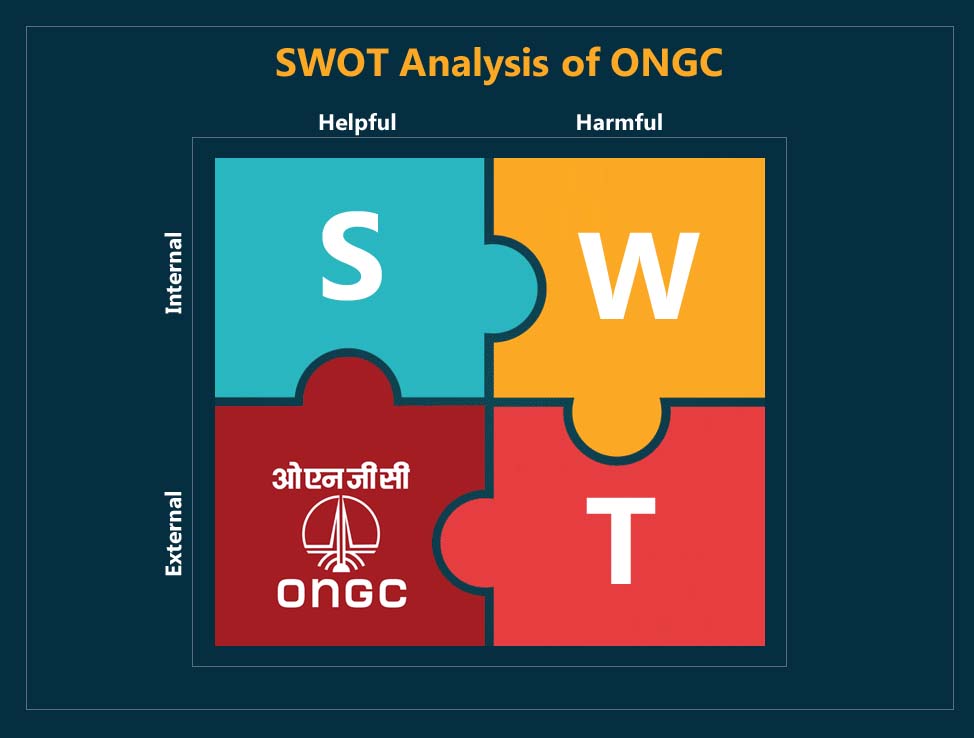
swot analysis of ongc

Strengths in the SWOT Analysis of ONGC – ONGC SWOT Analysis

Brand equities

The ONGC has invested in building a strong portfolio of brands and has ensured the creation of an environment conducive to the growth of the Indian economy. It has played a positive role in India’s growth cycle and has CSR projects that have focused on a variety of underdeveloped regions of the country. ONGC has been rated as the Best Employer and has a respectable reputation on both the Indian and international markets.

Engineering: Engineering

ONCG guarantees the consistency of its goods through the integration of operations, and has also allowed the organization to scale up and down its capacities, based on the requirements on demand. The company has set up EPINET, a live E&P information network. The ONGC already has 3D visualization centers known as the “Third Eye” for the integration of offshore and onshore knowledge in real time. The organization has a Memorandum of Cooperation (MOC) with seven IITs to pursue advanced R&D projects.

Focusing on sustainability

The ONGC has assured that it preserves and manages the climate and that the coordinated Health, Security & Climate (HSE) system has proactively controlled the environment. The organization seeks to reduce the environmental effects that can be generated by operations such as fracking, mining and development by engaging in successful solid waste disposal, environmental inspection and analysis, and resource control programs.

The organization now maintains an ONGC Natural Gas STAR initiative to facilitate the successful execution and monitoring of efficient and cooperative methane emission reduction programs.

Strong Group Dealer

The ONGC has a large dealer network by creating a culture among dealers and distributors by encouraging them not only to support the company ‘s goods, but also to engage in educating and preparing the sales team to understand and maintain a relationship with the consumer and help them achieve the most benefits from the goods.

swot analysis of ongc - 1

Weaknesses in the SWOT Analysis of ONGC – ONGC SWOT Analysis

Competition :

Tata Petrodyne, a subsidiary of the TATA group, is considered to be one of the largest oil and gas firms with a turnover of about $200 billion. Oil India Limited (OIL) is also known to be the second largest hydrocarbon firm E&P (Exploration & Production) and has more than 11,000 workers with a turnover of $35 billion.

Bharat Petroleum has large refineries in Cochin and Mumbai and has been listed by Fortune 500 firms. Such firms have been engaging in numerous R&D initiatives and the ONGC will take strategic steps to keep ahead of competition.

Investment in research and technology

Investment by the organization in research and development is said to be below the leading players in the industry. While the ONGC spends a fair deal on the R&D side, the business has not been able to compete with the leading players in the industry when it comes to innovation. The brand has come off as a business that wants to carry out goods based on the functionality testing.

Opportunities in the SWOT Analysis of ONGC – ONGC SWOT Analysis

Higher petrol costs

Due to increase in crude oil prices their can be a substantial increase in the Petrol prices which will lead to substantial gains for the company’s.

Research:

The company has established the Gas Hydrate Research & Technology Center (GHRTC). This center is contributing to the Government of India ‘s initiative to commercialize gas hydrates as an energy tool. This ONGC center has been active in finding deep-sea gas hydrate deposits on the coast of India, with fresh deposits valued at 134 trillion cubic feet. Analysis efforts performed in this manner would allow the organization to pursue new opportunities.

Threats in the SWOT Analysis of ONGC – ONGC SWOT Analysis

Regulation of the Government

There is also a danger to the company’s income from evolving regulatory legislation. There have been occasions where the government has asked the ONGC to help slash oil and diesel rates. There are occasions where it has been stated that the government has asked the company to bear the increase in oil prices at Rs 1 per liter. Such laws specifically impact the income of the ONGC.

Electrical engines

According to the International Energy Agency, more efficient fuel technologies and electric cars are projected to reduce the need for oil transport by 2040, but it is also said that the world will face a supply shortage without a strong investment in new development. The efficiency of EV and even ride-sharing developments are projected to reduce oil use and demand for oil should rise more gradually in the next decade.

Fluctuating levels of crude oil

The fall of the rupee, even though it is said to contribute a minor sum to the increasing cost of energy. Global oil prices soared by 45 percent in terms of the dollar and the increase was 49 percent in the rupee. The rise in oil prices would lead to inflationary pressures and push RBI to lift interest rates.

If you like This Article Please Like our Facebook Page PROJECTS4MBA

Cite This Work

Referencing Style to cite this article:
[citationic]

SWOT Analysis of ONGC [step by step SWOT] Read More »