SWOT Analysis of Flipkart [step by step SWOT]

SWOT Analysis of FLIPKART focuses on (S) Strengths, (W) Weakness, (O) Opportunities, and (T) Threats. Internal Factors in the SWOT Analysis are Strengths and Weaknesses and External Factors in the SWOT Analysis are Opportunities and Threats.

SWOT Analysis is a proven management tool that helps organizations such as Flipkart to assess the e-commerce market and its success against rival companies. Flipkart has been one of the leading e-commerce giants.

Flipkart is a top e-commerce company in India. There are very few Indian companies worth more than $2bn and Flipkart is worth more than $11bn as of today. Flipkart was established by Binny and Sachin Bansal in the year 2007. They have worked hard and took the company to great heights.

In this article we will discuss SWOT Analysis of Flipkart.

swot analysis of flipkart - 1

Strengths in the SWOT Analysis of Flipkart – Flipkart SWOT Analysis

  • India’s Top Online Store: Flipkart is India’s e-commerce giant and has a revenue of 6.1 Billion.
  • Subsidiaries of Flipkart: Flipkart has subsidiaries like Myntra, Jabong, PhonePe, Jeeves, 2GUD, and E-kart.
  • Experienced entrepreneurs: Ex-Amazon workers are creators of Flipkart, Binny Bansal & Sachin Bansal. Experience in e-commerce was fruitful for the owners of Flipkart and they have achieved great heights and bale to create a good brand image of the company.
  • High Brand Recall: Through TV advertising, online branding, and social media presence, Flipkart has established itself as a renowned e-commerce company in India. Brand events such as the “Big Billion Day” have greatly improved the company’s brand recall.
  • Own Payment gateway & Logistic arm: Getting its own Logistics arm E-kart & Payment gateway Payzippy has helped the company manage its expenses. Thereby moving the benefits on to the end customers.
  • Exclusive & broad product range: By having exclusive rights to launch such items such as Moto, Xiaomi 10 Pro as well as divisions of personal designers in the category of clothes, the company has helped to distinguish and localize its items.
  • In House Brands: Flipkart is promoting it’s in house brands. This will help Flipkart to achieve more profits.
  • Walmart Stake in Flipkart: Walmart has recently increased its stake and invested a huge amount in Flipkart to overcome the loss in the pandemic situation.
  • Tie-ups with Well Established Brands: Flipkart has tie-ups with Xiaomi, Philips, Realme, Nokia, Samsung, Oppo, Vivo, Motorola, etc.
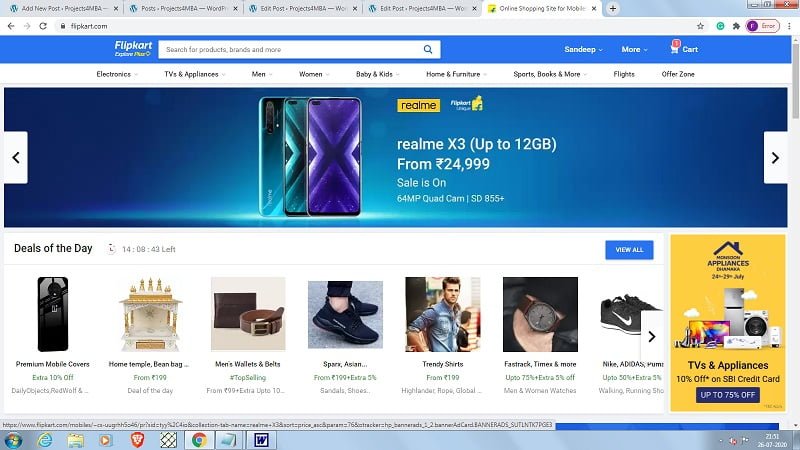
swot analysis of flipkart

Weaknesses in the SWOT Analysis of Flipkart – Flipkart SWOT Analysis

  • Small channel distribution reach: while its logistics arm has kept the cost small, Flipkart ‘s weakness has affected scope. Global companies like Amazon & eBay will distribute the goods to anywhere in the world due to the use of outsourcing. Flipkart still struggles in this region, though.
  • Promotion cost: The Promotion cost is high because Flipkart is using aggressive promotional strategies to promote its products. Average spending of flipkart for promotion is Rs. 400 on each customer.
  • Power in buyers’ hands: Since this market is filled with lots of competitors, consumers have a lot of choices to make. Customers often have lower switching costs, as they can quickly switch a service from one online shopping business to another. Many online shopping websites will feature the same items. Product differentiation is nearly absent and the struggle then starts only on the basis of price.

Opportunities in the SWOT Analysis of Flipkart – Flipkart SWOT Analysis

  • Business expansion: By targeting other emerging market businesses, they will boost their sales as well as have Scale Economies.
  • Expansion in Product Categories: This will boost its customer base and reduce acquisition costs and customer switching costs.
  • Changing Indian customer mentality: Due to Pandemic Situation, there is a shift towards online shopping.
  • Internet Usage: Increasing Internet Usage may change the attitude towards Online Shopping.
  • Supply chain: By managing their supply chain, they can compete with other players & handle the losing sales due to the distribution constraints of the product not being made available.
  • Establishing in other emerging economies: Like Amazon, Flipkart will start expanding gradually out of India and also set up operations in other countries that will help to increase revenues.

Threats in the SWOT Analysis of Flipkart – Flipkart SWOT Analysis

  • Competition: Stiff competition from multinational players such as Amazon, eBay as well as from local players such as Snapdeal, Tolexo, and Shopclues who are actively trying to steal a market share of each other.
  • Government controls on FDI problems in the multi-branding retail sector have been a big obstacle in India’s e-commerce industry’s success.
  • High Sellers Commission: Seller’s commission is very high. If a company offers fewer sellers commission then sellers may switch to those e-commerce Platforms.
  • Government Control over distribution in restricted areas can also be a major Threat.

If you like This Article Please Like our Facebook Page PROJECTS4MBA

Cite This Work

Referencing Style to cite this article:
[citationic]

SWOT Analysis of Flipkart [step by step SWOT] Read More »
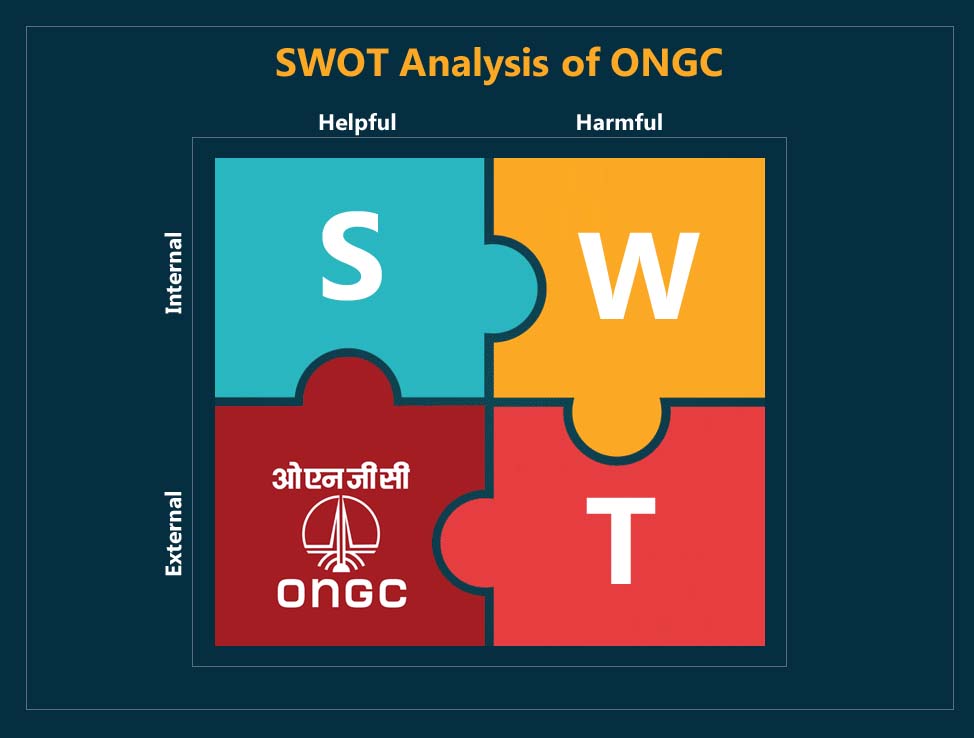
SWOT Analysis of ONGC [step by step SWOT]

SWOT Analysis of ONGC focuses on (S) Strengths, (W) Weakness, (O) Opportunities, and (T) Threats. Internal Factors in the SWOT Analysis are Strengths and Weaknesses and External Factors in the SWOT Analysis are Opportunities and Threats.

SWOT Analysis is a proven management tool that helps organizations such as ONGC to assess the market of Oil and Gas and its success against rival companies. ONGC has been one of the leading Oil and Gas Company.

The Oil and Natural Gas Corporation (ONGC), is an oil and gas giant company and has a registered office located at New Delhi. ONGC was founded on 14 August 1956. ONGC is a public sector undertaking of the Government of India and is also India’s largest gas producer and exploration company.

It contributes 70 percent to India’s crude oil output and has a 62 percent natural gas share. The ONGC has commercially found 6 out of 7 Indian basins. It has led and passed several milestones in India’s energy ambitions. It has grown to become one of the largest E&P firms in the world in terms of revenue and reserves.

swot analysis of ongc

Strengths in the SWOT Analysis of ONGC – ONGC SWOT Analysis

Brand equities

The ONGC has invested in building a strong portfolio of brands and has ensured the creation of an environment conducive to the growth of the Indian economy. It has played a positive role in India’s growth cycle and has CSR projects that have focused on a variety of underdeveloped regions of the country. ONGC has been rated as the Best Employer and has a respectable reputation on both the Indian and international markets.

Engineering: Engineering

ONCG guarantees the consistency of its goods through the integration of operations, and has also allowed the organization to scale up and down its capacities, based on the requirements on demand. The company has set up EPINET, a live E&P information network. The ONGC already has 3D visualization centers known as the “Third Eye” for the integration of offshore and onshore knowledge in real time. The organization has a Memorandum of Cooperation (MOC) with seven IITs to pursue advanced R&D projects.

Focusing on sustainability

The ONGC has assured that it preserves and manages the climate and that the coordinated Health, Security & Climate (HSE) system has proactively controlled the environment. The organization seeks to reduce the environmental effects that can be generated by operations such as fracking, mining and development by engaging in successful solid waste disposal, environmental inspection and analysis, and resource control programs.

The organization now maintains an ONGC Natural Gas STAR initiative to facilitate the successful execution and monitoring of efficient and cooperative methane emission reduction programs.

Strong Group Dealer

The ONGC has a large dealer network by creating a culture among dealers and distributors by encouraging them not only to support the company ‘s goods, but also to engage in educating and preparing the sales team to understand and maintain a relationship with the consumer and help them achieve the most benefits from the goods.

swot analysis of ongc - 1

Weaknesses in the SWOT Analysis of ONGC – ONGC SWOT Analysis

Competition :

Tata Petrodyne, a subsidiary of the TATA group, is considered to be one of the largest oil and gas firms with a turnover of about $200 billion. Oil India Limited (OIL) is also known to be the second largest hydrocarbon firm E&P (Exploration & Production) and has more than 11,000 workers with a turnover of $35 billion.

Bharat Petroleum has large refineries in Cochin and Mumbai and has been listed by Fortune 500 firms. Such firms have been engaging in numerous R&D initiatives and the ONGC will take strategic steps to keep ahead of competition.

Investment in research and technology

Investment by the organization in research and development is said to be below the leading players in the industry. While the ONGC spends a fair deal on the R&D side, the business has not been able to compete with the leading players in the industry when it comes to innovation. The brand has come off as a business that wants to carry out goods based on the functionality testing.

Opportunities in the SWOT Analysis of ONGC – ONGC SWOT Analysis

Higher petrol costs

Due to increase in crude oil prices their can be a substantial increase in the Petrol prices which will lead to substantial gains for the company’s.

Research:

The company has established the Gas Hydrate Research & Technology Center (GHRTC). This center is contributing to the Government of India ‘s initiative to commercialize gas hydrates as an energy tool. This ONGC center has been active in finding deep-sea gas hydrate deposits on the coast of India, with fresh deposits valued at 134 trillion cubic feet. Analysis efforts performed in this manner would allow the organization to pursue new opportunities.

Threats in the SWOT Analysis of ONGC – ONGC SWOT Analysis

Regulation of the Government

There is also a danger to the company’s income from evolving regulatory legislation. There have been occasions where the government has asked the ONGC to help slash oil and diesel rates. There are occasions where it has been stated that the government has asked the company to bear the increase in oil prices at Rs 1 per liter. Such laws specifically impact the income of the ONGC.

Electrical engines

According to the International Energy Agency, more efficient fuel technologies and electric cars are projected to reduce the need for oil transport by 2040, but it is also said that the world will face a supply shortage without a strong investment in new development. The efficiency of EV and even ride-sharing developments are projected to reduce oil use and demand for oil should rise more gradually in the next decade.

Fluctuating levels of crude oil

The fall of the rupee, even though it is said to contribute a minor sum to the increasing cost of energy. Global oil prices soared by 45 percent in terms of the dollar and the increase was 49 percent in the rupee. The rise in oil prices would lead to inflationary pressures and push RBI to lift interest rates.

If you like This Article Please Like our Facebook Page PROJECTS4MBA

Cite This Work

Referencing Style to cite this article:
[citationic]

SWOT Analysis of ONGC [step by step SWOT] Read More »

SWOT Analysis of Fevicol [Explained in Detail]

SWOT Analysis of Fevicol – Fevicol SWOT Analysis focuses on Strengths, Weakness, Opportunities, and Threats. Internal Factors in the SWOT Analysis are Strengths and Weaknesses and External Factors in the SWOT Analysis are Opportunities and Threats.

SWOT Analysis is a proven management tool that helps Fevicol to assess its market and its success against rival companies. Fevicol is the market leader for Adhesives and glues.

Fevicol is an adhesive, glue, and sealant industry that was established during the year 1959 in India. It is owned by Pidilite Industries Limited, an Indian company. Fevicol is first marketed in India for easy-to-use glue for carpenters. It was used as a standby for collagen and fat adhesives that requires boiling before application. As Fevicol is used extensively in craftsmen, consumer, engineering, and industrial adhesives, it is marketed in about 54 countries that include about 50,000 locations in India.

The brand Fevicol glue is a white adhesive that looks like a white viscous paste. The company prepares many variants of the product that is designed for various features like bonding, impact resistance, sagging, time to set, versatility, shrinkage, shock and vibration resistance, fire resistance, etc.

Fevicol MR is used for cardboard, bonding paper, fabrics, plywood, and wood. Fevicol SH strongly binds wood, laminate, veneers, plywood, MDF, and all types of cork and boards. Fevicol is the strongest selling brand of adhesives in India.

swot analysis of fevicol

Strengths in the SWOT Analysis of Fevicol – Fevicol SWOT Analysis

  • Brand value – Fevicol being a popular brand, has been a household name for many generations and has become a replacement with anything that holds items together. This brand is the biggest bond for the Pidilite. This brand has introduced many innovative products that have helped to re-generate carpentry trade in India.
  • Marketing Strategy – The viral advertising campaign has been a development in the company’s marketing strategy that is a great fit to the company’s business.
  • Strong distribution network – Fevicol has a strong supply and distribution network throughout India. The company has about 65,000 dealers and retailers who help the company to sell its product. Because of this, Fevicol has become a popular brand and has excellent visibility among its customers.
  • Customer-friendly approach – Fevicol having many SKUs and packages, projects a very customer-friendly approach, and also ease of application.
  • Global presence – Fevicol has an excellent market reach by reaching out to countries like Singapore, Indonesia, South Africa, Thailand, Japan, and Chain. There is also an increase in sales for this brand in these regions.
  • Good market share – Being the market leader in India in the adhesive category, Fevicol has a majority market share.
  • Many brands – Fevicol has been into continuous innovation that leads to new and improved products, that help the company to keep pace with the evolving needs of the customer. Each and every innovation has been prepared to keep in the requirement for a strong adhesive.
  • Aggressive Advertising Strategy – TV Ads with good recall value and frequency of giving advertisement on Television is good.

Weaknesses in the SWOT Analysis of Fevicol – Fevicol SWOT Analysis

  • Fewer schemes for carpenters – Fevicol does not have many schemes or offers for carpenters that are a great weakness for the brand. Carpentry is an evergreen business in India and they are the largest customers of this brand.
  • Increasing the brand’s global presence – Fevicol has a limited market in the international presence, that is, in fact, a big weakness to it. It should expand its horizon towards European, Middle East, and American nations. This will increase their sales and market share.
  • Carpenter focused – Fevicol brand is more focused on carpentry. Since its area of application is limited to a particular sector, it is a great weakness to the brand.

Opportunities in the SWOT Analysis of Fevicol – Fevicol SWOT Analysis

  • Promotional activities – Various Below-the-line promotional activities Fevicol MR Buddy series, Champions Club for carpenters, etc. involves children for art and craft exhibition to exhibit their talent. This is a great show to broadcast their brand and also to increase their brand awareness.
  • Product variant – Many variations in product and extensions like Fevicol Speed, binding things fast, and Fevicol Marine, an underwater usage has been a great hit among the customers for their respective work.
  • Increasing demand for furniture – The customer’s purchase of wooden furniture is always increasing, which is a good sign of opportunity in the Fevicol brand.

Threats in the SWOT Analysis of Fevicol – Fevicol SWOT Analysis

  • Less adhesive industry – There seems to be less entry barrier for the adhesive industry and due to which new competitors can enter the market very easily. This is a huge threat to the business.
  • The decrease in the global economy – Global trade gets hit due to the global economic decline and due to which exports are affected. Hence, this is a threat to the business.
  • Crisis in advertising – There has been a dip in the advertising of Fevicol that results in reduced brand recall.
  • Raw material – The raw material of Fevicol is dependent on crude oil prices. So the company’s business operation cost gets fluctuated due to this. This is, in fact, a serious threat to the business.

If you like This Article Please Like our Facebook Page PROJECTS4MBA

Cite This Work

Referencing Style to cite this article:
[citationic]

SWOT Analysis of Fevicol [Explained in Detail] Read More »

SWOT Analysis of Walmart – Walmart SWOT Analysis [Detailed]

SWOT Analysis of Walmart – Walmart SWOT Analysis focuses on (S) Strengths, (W) Weakness, (O) Opportunities, and (T) Threats. Internal Factors in the SWOT Analysis are Strengths and Weaknesses and External Factors in the SWOT Analysis are Opportunities and Threats.

SWOT Analysis is a proven management tool that helps Walmart to assess its market and its success against rival companies. Walmart is one of the largest retail store in the world.

Walmart is one of the favorite Retail Store of a large number of population in the world. Walmart is the largest retail company in the world that sells groceries, electronics, clothes, office supplies, home, and kitchen accessories. Walmart stores have a recorded footfall of 270 million customers for purchasing, while many make purchases online through the website of Walmart.

Walmart opened its first discounted store in Arkansas in the year 1962. With over 11,200 stores in 27 countries and websites (e-commerce) in 10 countries, it has now grown into the largest retailer for 50 years. Walmart ‘s new Executive Director is Doug McMillon.

swot analysis of walmart

Strengths in the SWOT Analysis of Walmart – Walmart SWOT Analysis

  • Product awareness – With millions of consumers visiting Walmart every day, it is the world’s best supermarket store. The online store of Walmart has more than 60 million items available.
  • Global Expansion – Walmart has a stake in ASDA, UK. ASDA is a UK based retailer. Walmart has recently increased its stake in Indian e-commerce giant Flipkart. In addition, it has established a joint venture with Bharti, India’s largest retail store. Such global acquisitions have proven to be a major success for the company.
  • Global presence – Walmart opened 47 new stores in Central America in 2017, 15 in Chile, 11 in Great Britain, and 4 in China. Its foreign activities expanded its global footprint and revenues.
  • Strategy for ‘Every Day Low Prices’-Walmart is focused on policy economies of scale, which is why it can deliver low prices. This has thousands of goods at fixed costs. Therefore it is one of the world’s cheapest shopping destinations.
  • International logistics and supply chain network-Walmart ‘s main competencies are the distribution and logistics networks. This uses information technology to track the output of each commodity in each store in each nation in an efficient manner.
  • Human Resource Planning-Walmart ‘s main assets are its employees. It spends large sums of its time and resources in creating and maintaining a good working environment for its employees and workers. According to Business Insider, nearly about 1 percent of America’s population is working at Walmart.
  • Good resource management – Walmart handles its resources effectively through information systems, distribution centers, good supply chain networks, expertise, and other competencies. Walmart’s operating procedure and management of the store are excellent.
  • Clear market control over suppliers and competitors – Walmart has been capable of exerting market influence over suppliers and competitors due to its wide organizational scale and global scope.
swot analysis of walmart - 1

Weaknesses in the SWOT Analysis of Walmart – Walmart SWOT Analysis

  • Wide control System – Walmart may be vulnerable in some places because of its organization size and its control system.
  • Thin profit margins-Walmart is focused on a plan for cost leadership. This results in the company having thin profit margins.
  • Gender discrimination – In 2007, a lawsuit was filed against Walmart allegedly claiming gender discrimination in Walmart employment opportunities. As regards pay scale and appraisal of female employees are discriminated against according to this complaint.
  • The imitation – The business model of Walmart can easily be copied. The company has no particular competitive advantage over its competitors except for its big and widespread stores in various countries.

Opportunities in the SWOT Analysis of Walmart – Walmart SWOT Analysis

  • Expansion to other countries – Walmart should take advantage of the ability to extend its business to countries that have not yet explored. These might include China, countries in Latin America, and the Middle East.
  • Strategic Alliances – Walmart has the opportunity to establish strategic partnerships or merge with other global retailers with major companies. Small business acquisitions can also reflect a lucrative opportunity for Walmart.
  • Improving human resource practices – Introducing advanced changes to human resource practices will provide Walmart with a beneficial opportunity. Given that it depends heavily on its workforce, adding creativity to the management of human capital is a critical opportunity.
  • Improving quality standards – Low-cost products sometimes render low quality. Walmart has the opportunity to improve quality standards for its products to address consumer health concerns.

Threats in the SWOT Analysis of Walmart – Walmart SWOT Analysis

  • Controversies related to employees, products can be a major threat.
  • Controversy over fake craft beer – Walmart was sued in 2017 for selling fake craft beer. Though produced by WX Brands, the beer was labeled and marketed as ‘Trouble Brewery,’ a non-existent manufacturing firm.
  • Competitors policy regarding discounts and offers – Walmart is on the target of most of the retail giants in the world and hence established players can give tough competition to Walmart.
  • Political and legal problems – It, too, is a challenge to political and legal matters that can also prevent the organization from working in other countries.
  • Small-scale online e-commerce firms – Some small-scale and individual online retailers have entered the market selling identical items on their websites at competitive rates. It may pose a challenge to the future status of the company.
  • Technical issues on the website – Consumers have frequently complained that Walmart ‘s website has some technical problems. The products are not listed on the website in an organized way and are running slowly. However, Amazon is known for its fast, efficient, and organized website making customers excellent online shopping experience.
  • Government Policies can also be a major threat to Walmart. Changes in FDI Policies can affect the profits of Walmart.

Recommendations for Walmart

Following suggestions Walmart will strengthen its weak points and enhance its potential market position:

  • Improving HR performance quality and addressing the issues of the employees. The successful HR program would discourage Walmart from making any potential assumptions regarding its employees.
  • Expansion of business to new markets – Walmart needs to pursue prospects for improving its role and growing market share in emerging markets.
  • Advancing the global supply chain and distribution network – It will strengthen its vast retail empire.
  • Addressing contentious topics at the earliest opportunity. Walmart needs to improve the website for online sales and offer only legitimate items to prevent more public scrutiny.
  • Upgrading of its e-commerce pages online. Walmart needs to solve technical problems that hinder the progress of the websites and offer the customers satisfying shopping experience.
  • Strengthening marketing and promotional efforts – it will help the organization boost its brand identity and attract new clients.
  • Walmart should also play an active role in environmentally friendly activities to give the company a positive picture.

If you like This Article Please Like our Facebook Page PROJECTS4MBA

Cite This Work

Referencing Style to cite this article:
[citationic]

SWOT Analysis of Walmart – Walmart SWOT Analysis [Detailed] Read More »

SWOT Analysis of Amul Chocolates [Step by Step SWOT]

SWOT Analysis of Amul Chocolates – Amul Chocolates SWOT Analysis focuses on (S) Strengths, (W) Weakness, (O) Opportunities, and (T) Threats. Internal Factors in the SWOT Analysis are Strengths and Weaknesses and External Factors in the SWOT Analysis are Opportunities and Threats.

SWOT Analysis is a proven management tool that helps brands such as Amul to assess the market of Amul Chocolates and its success against rival companies. Amul has been one of the Chocolates Manufacturer of the country.

Amul Chocolates is a product of the Chocolate Company Amul, which is the brand name of the Gujarat Cooperative Chocolate Marketing Federation. Since the green movement launched by Shri Verghese Kurien, the cooperative organization manufactures Chocolates and various Chocolate goods such as curd, milk, chocolate powder, milk spread and cocoa, among others.

Amul Chocolates also includes Amul Chocozoo and Chocolate Syrup. The firm reported a turnover of USD 6 billion in 2016 and is a licensed cooperative firm with very strong faith and recall in India. After being incorporated as a cooperative corporation in 1946, GCCF has assisted the growth and production of a number of dairy farmers by coordinating the acquisition, manufacturing, and selling of the chocolates they have supplied. Chocolates are one of Amul’s most popular items.

swot analysis of amul chocolates - 1

Strengths in the SWOT Analysis of Amul Chocolates – Amul Chocolates SWOT Analysis

  • Strengths are described as what each company does best in its field of activities, which can give it the upper hand over its competitors. The attributes of Amul Chocolates are as follows:
  • Advertisement: Amul Chocolates has benefited immensely from the marketing strategies of the brand, including the corporate symbol, the Amul Girl, and its tagline Taste of India, thanks to its affiliation with Amul.
  • Continuous spirit of innovation: Amul takes influence from leading confectionery firms around the world and innovates in their chocolates. This has resulted in a new range of dark chocolate and chocolate syrup. The spirit of novelty is also expressed in their ad strategies and packaging.
  • Focus on the Amul brand: One approach that has benefited the business as a whole is that, instead of selling individual products, the emphasis has also been on the Amul brand. This has contributed to the creation of credibility and confidence expressed in many of its products, including its chocolates.
  • Distribution channel: Amul follows a three-tier distribution system for all its products, where their goods are manufactured on three levels from village to district to state and then sold on three tiers, including business, wholesaler, and retailer. It means optimum coverage for Amul Chocolates.
  • Focus on quality: Amul Chocolates has never sacrificed consistency. The company takes every practicable measure to ensure that all requirements imposed by the different environmental, protection and consistency regulatory bodies are completely complied with.
swot analysis of amul chocolates

Weaknesses in the SWOT Analysis of Amul Chocolates – Amul Chocolates SWOT Analysis

Weaknesses are used to refer to situations that the company or the brand wants to change. Many of the main drawbacks of Amul Chocolates are as follows:

  • Lack of significance: Amul has never given adequate attention to its chocolates, and the vertical segment has always been considered to be of low value, with the company preferring to concentrate on butter or cheese.
  • Lower number of variants: relative to rivals such as Cadbury, the number of variations of chip chip chocolate is small. It contributes to dissatisfaction among consumers who, given the fact that chocolate is better in quantity and consistency, do not choose it brand.
  • High marginal selling cost: the demand for confectionery is intensely competitive and the transaction is targeted towards an opportunity to buy behaviour. It ensures that only advertising can cause sales. However, the marginal expense of marketing is small and so the number of chocolate ads is limited.
  • Poor differentiation: the consumer is unable to differentiate between different chocolate products as the segment does not have anything to give in terms of a clear distinction in flavor or texture.
  • Focus on a regional market: most of Amul ‘s goods are linked to Chocolates and the source is only a single city, Gujarat. Procurement and management of chocolates and the production of chocolates is a supply chain challenge.

Opportunities in the SWOT Analysis of Amul Chocolates – Amul Chocolates SWOT Analysis

  • Opportunities apply to all environmental ways that affect the company on which it can leverage to maximize its profits. Some of the possibilities include:
  • Healthy chocolates: People are becoming more mindful of their health, generating a growing demand for low-calorie and sugar-free chocolate. Dark chocolate is also a favorite choice for customers. These are aspects that Amul Chocolates can look into.
  • Steep growth opportunities in developing economies: the global demand for confectionery had a sales value of $184,056 million in 2015, and growth of CAGR 3.4% is projected to hit $232,085 million by 2022. Industries should capitalize on that.
  • Chocolate flavored products: Amul should look at chocolate flavored products such as chocolate paste, cream biscuits, chocolate cookies, etc. as chocolate is a popular favorite among children.

Threats in the SWOT Analysis of Amul Chocolates – Amul Chocolates SWOT Analysis

Threats are those environmental factors that can be harmful to business development. Several of the risks are as follows:

  • Competition: Amul’s major rivals are Perfetti Van Melle, Mars, Cadburys,  Lindt, etc.
  • Low barriers to entry: the demand for confectionery has small barriers to entry, with the result that many new entrants are joining the demand. There is still a large market for handmade chocolates today, which is proving to be a challenge to packaged chocolates.
  • Government policies for chocolate manufacturing companies can be  major threat.

If you like This Article Please Like our Facebook Page PROJECTS4MBA

Cite This Work

Referencing Style to cite this article:
[citationic]

SWOT Analysis of Amul Chocolates [Step by Step SWOT] Read More »

SWOT Analysis of Amul Milk [Detailed Step by Step SWOT]

SWOT Analysis of Amul Milk – Amul Milk SWOT Analysis focuses on (S) Strengths, (W) Weakness, (O) Opportunities, and (T) Threats. Internal Factors in the SWOT Analysis are Strengths and Weaknesses and External Factors in the SWOT Analysis are Opportunities and Threats.

SWOT Analysis is a proven management tool that helps brands such as Amul to assess the market of Amul Milk and its success against rival companies. Amul has been one of the Milk and Milk product Manufacturer of the country.

Amul was a game-changing brand in India. The company is headquartered in Anand, Gujarat, and was founded in 1948. Amul milk is used in almost all urban households in India and is a well-known product. Amul products are also available in 60 countries around the world.

Amul milk has been the pioneer of India’s white movement and has established itself as India’s largest food company. Amul milk comes in various varieties, making it unique and useful to its consumers. It also provides lactose-free milk to people who are lactose-intolerant.

Other than milk Amul also manufactures products such as cheese , butter, paneer, etc. Amul milk is produced by the various industries that they have throughout India, and the milk is sourced from India.

swot analysis of amul milk

Strengths in the SWOT Analysis of Amul Milk – Amul Milk SWOT Analysis

  • Strengths are the building blocks of a company, and they have helped the company to find a place in the country. Strength is the point of difference between them and other companies. Here are the strengths of Amul Milk:
  • Variety in their products: the Company has made it easy to offer a wide variety in forms of milk. Amul milk is found in variants such as Amul Gold, Amul Tazza and Amul Slim n’ Trim, Amul spray for infants and much more based on the region. We also manufacture UHT-treated milk wrapped in a Tetra bag to improve the shelf life of milk.
  • Clear commercials: Amul milk has one of India’s best commercials. About every urban resident is conscious of the Amul girl they use for promotional purposes. We make her important to the issues that are going on in the world.
  • Good quality of the product: Amul milk has a distinct taste and a very high consistency. Milk is hygienically pasteurized and comes from local cows with a healthy diet. The packaging with which it is packaged is fine, and the milk is handled in the best of the factories.
  • A source initiative: Amul milk comes from farmers offering the highest quality milk. It makes farmers get the money they earn, and Amul makes them grow their milk products.
  • Strong distribution and supply chain: Amul milk, particularly Amul Tazza, can be found throughout India. Both milk shops have them because of the need that the industry has generated on the market.
  • Keeping up with the trend: Amul milk has been following trends for a long time. They developed a lean n ‘fit version for health-conscious people. Just as lactose-free milk is also very beneficial to those who are allergic to it.
swot analysis of amul milk - 1

Weaknesses in the SWOT Analysis of Amul Milk – Amul Milk SWOT Analysis

  • Weaknesses are the characteristics that a organization actually lacks. Understanding that helps the company grow more. Here are some of the drawbacks of Amul milk.
  • Rising rivalry market: Amul milk competitors are on the rise. Companies like Britannia, Go, Nestle and Mother Dairy are still getting ahead of the curve.
  • Cost price: Amul-milk varieties tend to be priced higher than other firms. The explanation Amul argues is because of their consistency, but buyers also prefer a lower priced version merely because of their affordability.
  • Tackling the rural market: people living in the rural belt prefer to have cow’s raw milk rather than the pasteurized variety. Better awareness of them would boost the demand.

Opportunities in the SWOT Analysis of Amul Milk – Amul Milk SWOT Analysis

  • Opportunities are the stage that a business can do well on the market. It allows a organization to grow faster, and here are some of the places where Amul can work:
  • Increase in distribution: Amul can add more types of milk variants that people would like. They ought to deliver it to places that have not yet been affected. They will also try the export of milk to numerous other nations.
  • Rural Belt Initiatives: Amul-milk should reach rural areas to teach them about the need to drink pasteurized milk. This would help them to expand the market a lot more.
  • Adding new variants: Indians are changing in taste, and they want different varieties. Amul will certainly look into the production of Almond and Coconut milk, which is gaining popularity day by day.
  • Price reduction: As discussed above, there are several price disparities. Amul milk can be repackaged in small variants to catch people’s attention.

Threats in the SWOT Analysis of Amul Milk – Amul Milk SWOT Analysis

  • Competitors: competitors may pose a threat to the company if they are able to produce more variants. People may take advantage of the offers that other companies are offering them.
  • Myth-busting of milk intake: some studies argue that the use of milk is excessive. And, if the idea spreads, it might hurt Amul Milk.
  • Diet and the health of the cows: this has not been a problem before, but with the emergence of organic and grass-fed foods people are wondering. Amul milk is expected to claim the diet of cows for a competitive price.

If you like This Article Please Like our Facebook Page PROJECTS4MBA

Cite This Work

Referencing Style to cite this article:
[citationic]

SWOT Analysis of Amul Milk [Detailed Step by Step SWOT] Read More »

SWOT Analysis of Amul Butter [Step by Step SWOT]

SWOT Analysis of Amul Butter – Amul Butter SWOT Analysis focuses on (S) Strengths, (W) Weakness, (O) Opportunities, and (T) Threats. Internal Factors in the SWOT Analysis are Strengths and Weaknesses and External Factors in the SWOT Analysis are Opportunities and Threats.

SWOT Analysis is a proven management tool that helps brands such as Amul to assess the market of butter and its success against rival companies. Amul Butter has been one of the leading butter manufacturers of the country.

Amul is an Indian dairy cooperative located in Anand, Gujarat. Amul is administered by the Gujarat Co-operative Milk Marketing Federation Ltd. (GCMMF). Amul Butter is one of the most popular goods in the Amul portfolio. The iconic Amul girl was first created in 1967 for Amul Butter in response to the rival brand of Polson Butter Girl. Throughout the years, the Amul Butter Girl has achieved immense fame and created a name for itself.

swot analysis of amul butter - 2

Strengths in the SWOT Analysis of Amul Butter – Amul Butter SWOT Analysis

  • Good Advertisements: Amul as a brand is known for its innovative advertisement of Amul Girl’s print, online, and social media ads. This generates a powerful Amul brand identity.
  • One of the best brand mascots: the Amul girl is one of the biggest brand mascots in India, and she’s famous for her funny hoardings that people are looking forward to seeing.
  • Strong market share: Amul has a leading market share in most products in its portfolio, particularly in the Butter category, where it has a market share of over 85 percent.
  • Excellent distribution channel: Amul has a very large distribution network, with a footprint throughout the world. It is sold through both new and conventional distribution networks.
  • Good product quality: Amul butter has been rated high on product quality and has been able to gain market confidence. It stands by its slogan, which reads “Amul – The Flavor of India.”
  • Affordable pricing: In order to maintain its high market share, Amul is committed to maintaining a low pricing strategy. It has a market-oriented pricing approach that is sustainable for the typical Indian household.
  • Consumer portfolio backup: because of Amul ‘s large product range, such as ice cream, milk, and other similar dairy goods, Amul will dominate the retailer by selling Amul butter.
swot analysis of amul butter

Weakness in the SWOT Analysis of Amul Butter – Amul Butter SWOT Analysis

  • People prefer local butter – Some people prefer to use homemade and local butter. This reduces the size of the market for Amul.
  • Rare limited advertising: Amul butter has a share of the drawbacks of being part of the Amul branded family. Although Amul is very popular as a brand, its products usually remain in the background and depend on Amul ‘s popularity.
  • Limited Shelf-life: Butter has a low shelf life and requires refrigeration to be able to preserve its form. Amul has a wide supply chain network that needs extra precautions considering the shelf life of its dairy products.

Opportunity in the SWOT Analysis of Amul Butter – Amul Butter SWOT Analysis

  • Developing the rural market: Amul should be available in small packets of special butter items for the rural market in order to tap into a high potential rural demand as well.
  • Tie-ups with hotels and restaurants: Amul will look forward to tie-ups with restaurants and hotel chains. It’s already got huge ties, but this is an ever-growing segment. This will help to increase revenue and profitability.
  • Launch new variants: Amul will plan to introduce new models to reach a larger consumer base. It has also been used in versions such as garlic butter and low-fat milk.

Threat in the SWOT Analysis of Amul Butter – Amul Butter SWOT Analysis

  • Local Players: Local Players who are manufacturing Butter can have an adverse effect on the market share of Amul and will hence also have an effect on profitability.
  • Growing health consciousness: increasing health awareness decreases the intake of dairy products, in particular butter. It is impacting the bottom line of the organization.
  • Rising Constituent Prices: Due to the excess demand for dairy goods and the growing cost of production, the cost of butter-like milk constituents is continuously increasing, which puts pressure on Amul to raise the prices of Amul butter.
  • Low-Fat Variants are Less Popular: Low Amul Butter variants like Amul Lite are less popular and therefore create an opportunity for competitors like Nutralite to create a market for themselves.

If you like This Article Please Like our Facebook Page PROJECTS4MBA

Cite This Work

Referencing Style to cite this article:
[citationic]

SWOT Analysis of Amul Butter [Step by Step SWOT] Read More »

SWOT Analysis of State Bank of India – SWOT Analysis of SBI

SWOT Analysis of SBI – SWOT Analysis of State Bank of India focuses on (S) Strengths, (W) Weakness, (O) Opportunities, and (T) Threats. Internal Factors in the SWOT Analysis are Strengths and Weaknesses and External Factors in the SWOT Analysis are Opportunities and Threats.

SWOT Analysis is a proven management tool that helps organizations such as State Bank of India (SBI) to assess the market of SBI and its success against rival companies. State Bank of India (SBI) has been one of the leading Stationery companies.

SBI does have its origins in 1806, but was later converted under different names, and finally SBI was created in Parliament on May 1955. Around the year 1959, SBI took over 8 state-owned banks and, since then, has started to develop in the service of citizens at various economic rates.

swot analysis of sbi

Strengths in the SWOT Analysis of SBI – SWOT Analysis of State Bank of India

swot analysis of sbi - 1
  • SBI is India’s biggest bank in terms of market share, sales, and reserves.
  • SBI has been ranked in the Fortune Global 500 list.
  • According to recent reports, the bank has more than 22141 branches and 58555 ATM’s.
  • The bank is active in 36 countries involved in currency traders around the world.
  • SBI has the first-mover edge of commercial banking facilities.
  • SBI recently updated its vision and mission statements indicating an indication of inclination towards new-age banking services.
  • State Bank of India has a huge employee base of 257252 employees.
  • SBI has revenue of 143306 Crore rupees (20 billion US Dollars).
  • The owner of the State Bank of India is the Government of India.
  • SBI has many subisidaries:
    • SBI Cards
    • SBI Life Insurance
    • Jio Payment Bank
    • Yes Bank
    • Andhra Pradesh Grameena Bank
    • Kavenri Grameena Bank
    • Vikas Bank.

Weaknesses in the SWOT Analysis of SBI – SWOT Analysis of State Bank of India

  • The lack of adequate technology-driven infrastructure relative to private banks
  • Employees are hesitant to fix issues efficiently due to better job stability, and the turnaround period for clients is lengthy relative to private banks.
  • The banks pay a large sum on their leased houses.
  • SBI has the largest number of employees in the banking sector, which is why the bank spends a considerable amount of its income on employees ‘ salaries.
  • Despite the modernization, the bank still conveys the perception of the traditional bank to new-age clients.
  • SBI does not draw corporate payroll accounts, and any government employee’s payroll accounts are now transferred to private banks for ease of service, unlike before.

Opportunities in the SWOT Analysis of SBI – SWOT Analysis of State Bank of India

  • The merger of SBI with five other banks, namely the State Bank of Hyderabad, the State Bank of Patiala, the State Bank of Bikaner and Jaipur, the State Bank of Travancore and the State Bank of Mysore, is at the approval stage.
  • Mergers would result in a rise in market share to protect its number one spot.
  • SBI aims to expand and invest in foreign activities due to a strong inflow of capital from the Asian economy.
  • As some of the banking activities are yet to be modernized, there is a greater opportunity for leveraging new technology and applications to enhance customer ties.
  • Young and talented graduate and B school pools are on the rise to open new horizons for the so-called “old government bank”.

Threats in the SWOT Analysis of SBI – SWOT Analysis of State Bank of India

  • Net profit of the year decreased from 9166.05 in the year 2010 to 7.370.35 in the year 2011.
  • This indicates that the market share of its close rival ICICI is that.
  • Other private banks, such as HDFC, AXIS bank, etc.
  • FDIs permitted in the banking sector was increased to 49%, which is a major challenge to SBI as citizens continue to turn to international banks for better banking services facilities and technology.
  • Other government banks, such as GNP, Andhra, Allahabad Bank, and Indian Bank, are coming up.
  • Customers prefer to switch to private banks and financial service providers for loans and mortgages, as SBI involves strict verification procedures and takes a long time to process.

If you like This Article Please Like our Facebook Page PROJECTS4MBA

Cite This Work

Referencing Style to cite this article:
[citationic]

SWOT Analysis of State Bank of India – SWOT Analysis of SBI Read More »

SWOT Analysis of Faber Castell [Step by Step SWOT]

SWOT Analysis of Faber Castell focuses on (S) Strengths, (W) Weakness, (O) Opportunities, and (T) Threats. Internal Factors in the SWOT Analysis are Strengths and Weaknesses and External Factors in the SWOT Analysis are Opportunities and Threats.

SWOT Analysis is a proven management tool that helps organizations such as Faber Castell to assess the market of Stationery and its success against rival companies. Faber Castell has been one of the leading Stationery companies.

Faber Castell is a famous stationery manufacturer which was founded in 1761 and is located in Stein, Germany. This is the largest maker of pencils, markers, art materials, and office equipment, such as slide rules, scissors, rulers, and erasers.

It also offers high-end publishing instruments and quality leather products. It operates in around 14 plants and 20 distribution centers across the globe. It has about 7000 employees and operates in about 100 countries.

The corporation sells its goods through 25 sales and distribution organizations. It has a wide variety of goods available at varying prices. It is a major maker of wooden pencils and has a wide variety of items for drawing , painting, graphic illustration and decorative cosmetics.

The company stands out for its creative products, its high quality, its dedication to tradition, and its environmental consciousness. In 1999, the organization purchased Creativity for Children, a major producer of goods for all age ranges of children. The organization has already launched Quality Children’s Art Goods for children or the Playing and Learning Series in the United States.

Let us explore Faber Castell ‘s SWOT analysis via this article.

Strengths in the SWOT Analysis of Faber Castell – Faber Castell’s SWOT analysis

  • Product range – Faber Castell offers a wide variety of products, from pencils,  compasses, markers, play & learning, painting & design, artistic workshop, general writing and tagging, fine printing, and gift finder.
  • Feasible price – Faber Castell products are offered at a reasonable price and are available at all price ranges. The company also has luxury products that target the upper-middle class as well.
  • A Strong Legacy – The organization has a good heritage of about 200 years and is a trusted brand in the stationery sector.
  • High quality – Faber Castell ‘s goods are of the best standards that other consumers want.
  • Global Reach – The brand is available in almost 100 countries and has a strong international distribution and advertising network that is specific to children’s channels.
  • Innovation and Creativity – The Faber Castell brand is renowned for its innovation and creativity as a pioneer. It offers quality development to deliver solutions with substantial benefits to end-customers. It stimulates its own creativity through an open working atmosphere, commitment and international commitment, dedication, and interdisciplinary work teams.
  • Social and Environmental Responsibility – Faber Castell has a consistent obligation and commitment to people and the environment. Products have social responsibility within the client, the society, and business partners. It continuously seeks environmentally friendly processes and materials that contribute to the preservation of the planet.
  • Customer Service – Faber Castell delivers excellent customer service philosophy and consistently delivers a high-quality experience.
swot analysis of faber castell - 1

Weaknesses in the SWOT Analysis of Faber Castell – Faber Castell’s SWOT analysis

  • Intense Rivalry – Faber Castell sees a number of competitors from other famous brands. It also faces strong competition from local brands and therefore has limited market share.
  • Product Identity – Since Faber Castell products are sold at all prices, it is difficult for customers to choose among premium and non-premium brands.
  • Less Loyalty among Suppliers – Loyalty among Suppliers appears to be low. It has a low level of allegiance between members of supply chain partners.

Opportunities in the SWOT Analysis of Faber Castell – Faber Castell’s SWOT analysis

  • Creative Goods – Faber Castell makes more innovative products in terms of style, color, and packaging. Each and every product is packed in a unique way that attracts the eyes of the customers.
  • Maintains Unique Brand Names – Faber Castell has a number of brand names for both premium and non-premium products. This helps them to maintain the uniqueness of their brands.
  • New Categories – The brand sees a lot of opportunities by expanding its range of products. It will boost the appeal of its brand by creating more new items.
  • Rapid economic expansion – As the US economy is growing faster than other developed countries, it gives Faber Castell an opportunity to expand to the US market. The company is always aware of the ways in which it operates on a market share basis.
  • Trends in the acceptance of high-end products – this is a perfect chance for Faber Castell to gain good name exposure in the luxury market.
  • Changing Customer Preferences – Customers are interested in trying out new products that offer a huge market opportunity.

Threats in the SWOT Analysis of Faber Castell – Faber Castell’s SWOT analysis

  • Duplicate Goods – Owing to the extensive use of technologies in the entire industry, the goods can quickly be duplicated and may have a negative impact on the company.
  • Threat from local brands – Due to the availability of many local brands, there is a serious threat to these brands as they are available at lower prices.
  • Brand Awareness – It is, in general, very difficult to increase brand recognition among the consumers since they do not have any differentiated goods.
  • Product Segment Commoditization – The biggest threat to the company is the increasing commoditization of the stationery industry.

If you like This Article Please Like our Facebook Page PROJECTS4MBA

Cite This Work

Referencing Style to cite this article:
[citationic]

SWOT Analysis of Faber Castell [Step by Step SWOT] Read More »

SWOT Analysis of Coca Cola [Step by Step SWOT]

SWOT Analysis of Coca Cola focuses on Strength, Weakness, Opportunity, and Threats. Strength and Weakness are internal factors and Opportunities and Threats are external factors.

SWOT Analysis is a proven management tool that helps organizations such as Coca Cola to assess the market of Softdrinks and its success against rival companies. Coca Cola has been one of the leading beverage companies.

Coca Cola was originated from Atlanta, Georgia and it is a world-famous beverage manufacturing company. The company has a huge employee base of 62600 employees.

Coca cola is a brand used in homes, restaurants, hotels, shops, offices, etc. You name it and Coca cola would have been heard from the place. Coca cola has a wide arsenal of products. Below is a SWOT Analysis of Coca cola.

Coca cola has a large assortment of merchandise. Let’s discuss the SWOT Analysis of Coca Cola.

swot analysis of coca cola

Coca Cola SWOT Analysis

Industry: Beverage
Founded: 29th January 1892; 128 years ago in Atlanta, Georgia, U.S.
Founders : John Stith Pemberton

Strengths in the SWOT Analysis of Coca Cola – Coca Cola SWOT Analysis

  • Company’s Aim: Company is giving special emphasis on manufacturing, marketing, retailing of soft drinks, fruit juices, and Water.
  • Promotions: Aggressive Promotional strategies have made Coca Cola as No.1 Softdrink manufacturers.
  • Net Income: Company’s Net Income is 8.70 Billion US Dollars.
  • Company valuation – Coca cola, one of the world’s most valuable companies, is valued at around $79.2 billion. This valuation includes the brand value, the numerous factories and assets spread all over the world, and the entire cost and profit of Coca cola ‘s operations. Brand Equity – Interbrand gave the highest brand value award to Coca cola in the year 2011. With its vast global presence and unique brand identity, Coca cola is definitely one of the most preferred brands with the highest mark equity.
  • Vast global presence – Coca cola is present in around 200 countries worldwide. Chances are, any country you ‘re heading to will find coca cola in that market. This vast global presence of coca cola also helped build the mammoth brand name.
  • Largest market share – The soda category has only 2 Major rivals – Pepsi and Coca cola. Coca cola is the clear winner and hence has the highest market share. Coca Cola ‘s growth drivers include coke, thumbs up, sprite, diet coke , limca, fanta,and maaza amongst all drinks.
  • Fantastic marketing tactics-unlike Pepsi , Coca cola still seeks to capture the heart of the people. Coca cola targets people of all ages where Pepsi ‘s goal is constantly changing and targeting young people. The targeting is also done by well-liked celebrities – such as Amitabh Bacchan, Aishwarya Rai, Sachin tendulkar, and Aamir Khan etc.
  • Customer Loyalty-Coca cola has a lot of customer loyalty with such strong products. The aforementioned products like Coca cola and Fanta have a huge following of fans. People are going to choose some soft drinks over others. Because of Coca cola’s fine taste it is difficult for the consumer to find alternatives.
  • Distribution network – Coca cola has the largest distribution network due to the demand for its goods in the country. At the other hand Coca cola has been able to maintain such a strong market share because of this efficient distribution network.

Weaknesses in the SWOT Analysis of Coca Cola – Coca Cola SWOT Analysis

  • Competition with Pepsi – Pepsi for Coca cola is a pain in the flesh. Had it not been for Pepsi, Coca cola would have been the strong market leader. The rivalry is intense in these two brands and we don’t think Pepsi can give up too easily.
  • Product diversification is low – Coca cola is missing from that segment, where Pepsi has made a smart move and diversified into the snacks segment with products such as Lays and Kurkure. The segment is also a strong revenue generator for Pepsi and would have been an extra revenue driver for the company if Coca cola had been present in this segment.
  • Absence of health drinks – When you watch the television, you ‘d know that today, obesity is a huge issue impacting people. The business environment is changing and people are taking action to make sure they don’t get obese. Carbonated drinks are one of the key causes of fat consumption and Coca cola is the biggest Carbonated Beverage producer. The inference is that beverage consumption in developed countries could fall as people prefer a healthy alternative.
  • Water management – Coca cola has been getting flak in the past because of its water control problems. Several groups raised lawsuits in the name of Coca cola due to their vast water consumption even in water-scarce regions. At the same time, people also blamed Coca cola for mixing pesticides to clear contaminants in the water. And for Coca cola water quality needs to be stronger.

Opportunities in the SWOT Analysis of Coca Cola – Coca Cola SWOT Analysis

  • Diversification – Diversification is the health and food industry would improve Coca cola ‘s offerings to its customers. This would also ensure that current customers get better profits by cross-selling their goods. The supply chain that distributes its drinks can also sell such snacks, sharing the expense of the supply chain.
  • Developing nations – Although developed nations have a high Coca Cola presence, these countries are moving slowly towards healthy beverages. The joy of carbonated beverages and soft drinks is still being brought to developing countries, however. Countries like India, which are developing and having a hot summer, find cold drink consumption nearly doubled during summers. The higher consumption in developing environment can thus be a good opportunity for Coca cola to capitalize on.
  • Packaged drinking water-With hygiene being a major factor in water use, Packaged drinking water has made its way into the minds of the people. Coca cola has a presence though Kinley in the packed drinking water segment. Though Kinley ‘s expansion is slow as of now, Kinley has enormous expansion potential. Thus Coca cola as a business will concentrate on Kinley ‘s growth as a brand and take it to the level of confidence that Bisleri has.
  • Improvement of the supply chain – Supply chain can be a major cost sinkhole with ever-increasing transport costs. The whole business of Coca Cola is focused on transport and distribution. Improvements in that field will always be necessary. Coca cola will also keep strict control of its supply chain and continue to change to reduce costs.
  • Market the Lesser Selling Products – There are many items in Coca Cola’s product range that have not gained recognition on the market. Coca Cola also needs to focus on marketing those products. Coca cola is understood to have made several expenses to launch those products. The promotion and subsequent increase in the selling of such goods would thus boost Coca cola ‘s revenues.

Threats in the SWOT Analysis of Coca Cola – Coca Cola SWOT Analysis

  • Sourcing of raw materials – The only danger to coca cola is water. Coca cola ‘s vulnerability was the alleged use of pesticides or massive water use. The challenge here, though, is that water scarcity is on the increase. With the changing climate, and regions of different countries facing water scarcity, somebody might sooner or later raise their fingers at drink companies. Thus, water sourcing is a feature that can crash on Coca cola ‘s head anytime. If water is limited or rationed, Coca cola may suffer a major decline in its revenue and distribution capacity. The same may also have an influence on its arch competitor Pepsi.
  • Indirect rivals – coffee chains are on the rise including Starbucks, Costa Coffee, Café Coffee Day, … These chains offer the Coca colas carbonated drinks a healthy competition. They may not be a major coke rivalry but they’re giving their soda business a dent. Similarly, wellness drinks like Real and Tropicana and energy drinks like Red Bull and Gatorade implicitly rob off-market share.
  • Local Competitors: Local Softdrink Manufacturer can be a major threat to the company.
  • Government Policies: Change in government policies regarding preservatives, Pet Bottles, etc can be a major threat to the company.
  • Declining Share Prices can be a major threat.
  • People are shifting towards local beverages like Fresh Lime Water and Natural Juices for increasing immunity can also be a big threat.

If you like This Article Please Like our Facebook Page PROJECTS4MBA

Cite This Work

Referencing Style to cite this article:
[citationic]

SWOT Analysis of Coca Cola [Step by Step SWOT] Read More »