SWOT Analysis

SWOT Analysis of Different Companies in India

SWOT Analysis of Punjab National Bank – PNB SWOT Analysis

SWOT Analysis of Punjab National Bank – PNB SWOT Analysis focuses on the Strength, Weakness, Opportunities and Threats. Strength and Weakness are the internal factors and Opportunities and Threats are external factors.

PNB or Punjab National Bank is a Public Sector Bank known for its banking and financial services. Headquarter of PNB is in New Delhi. It is a second largest Public Sector Bank and founded in the year 1894.

Strengths in the SWOT Analysis of Punjab National Bank – PNB SWOT Analysis

  • Large  Customer Base : PNB is having one hundred and eighty million customers.
  • Large  Network of Branches and ATM’s : PNB has 10910 branches, and a wide ATM network of 13000+ ATMs.
  • Acquisition: Some of the Popular Bank like United Bank of India and OBC (Oriental Bank of Commerce) was merged in PNB on April 1st 2020.
  • International Presence: PNB has also marked its presence in United Kingdom China, Dubai, Hong Kong, Kabul, Bhutan, Kazakhstan and Kowloon.
  • Financials: Total Revenue of PNB in the year 2020 was 11 Billion US Dollars and Net Income was 47 Million US Dollars.
  • Large Employee Base : PNB has a large employee base of 103000 employees as.
  • Subsidaries: PNB Housing Finance, PNB MetLife Insurance, PNB Investment Services, PNB International Ltd. and PNB Gilts Limited are the subsidaries of Punjab National Bank.
  • Strong IT Infrastructure: Punjab National Bank has a strong IT Infrastructure.
swot analysis of punjab national bank

Weakness in the SWOT Analysis of Punjab National Bank – PNB SWOT Analysis

  • Presence in Rural Areas : PNB has less presence in rural areas.
  • PNB is not giving emphasis on advertising as compared to other public and private sector banks.

Opportunities in the SWOT Analysis of Punjab National Bank – PNB SWOT Analysis

  • PNB can also start E-Wallets which are trending in the country.
  • E-Gateway can be offered to the website owners at a nominal price.
  • Growing demand of Banking in the country creates a good opportunity for the Bank.
  • Bank can give emphasis on business loans to attract more customers.
  • Bank can also launch new schemes for Saving Account Holders to increase its cash deposit ratio.
  • Bank can also promote its products by using social media platforms and advertising platforms like Google Ads and Facebook Ads.

Threats in the SWOT Analysis of Punjab National Bank – PNB SWOT Analysis

  • Fluctuations and Crises in the Economy is the major threat.
  • RBI and Government Regulations is also a threat to the Bank.
  • New and Old Competitor Banks are also a threat.

If you like This Article Please Like our Facebook Page PROJECTS4MBA

Cite This Work

Referencing Style to cite this article:
[citationic]

SWOT Analysis of Punjab National Bank – PNB SWOT Analysis Read More »

SWOT Analysis of Pizza Hut [Explained]

SWOT Analysis of Pizza Hut Focuses on the Strength, Weakness, Opportunities and Threats. Strength and Weakness are the internal factors and Opportunities and Threats are external factors.

SWOT Analysis can be used to formulate strategies accordingly. Pizza Hut is an Italian Fast Food chain operating in India. The SWOT study of Pizza Hut is discussed in this article. The market climate for food and beverages in India is perfect as many food retail chains have come to India. Consumers in India have higher disposable incomes and have acquired the taste of luxury and choice at the same time. Fast food franchises like Pizza Hut is gaining recognition and expanding at a rapid pace.

swot analysis of pizza hut - 1

Strengths in the SWOT analysis of Pizza Hut – Pizza Hut SWOT Analysis

  • Pizza hut has a premium position in the mind of the customer because it was the first entrant to launch the Indian pizza franchise.
  • Pizza hut’s promotions and brand equity are better than competitors.
  • The range of pizza and pasta is outstanding and Pizza hut delivers on its promise to have an excellent Italian meal.
  • The food is of good quality and so is the atmosphere in every restaurant at Pizza Hut. Pizza hut also gets decent margins due to its higher costs, thereby giving Pizza hut an excellent sustainability advantage.
  • The brand has an excellent presence online and offline with Pizza hut delivery giving home delivery and Pizza hut also having an online ordering system for its pizza.
  • Pizza Hut specialises in making pizzas.
  • Pizza Hut has no competitors for pizza and they face very little market competition.
  • Pizza Hut has a wide variety of Pizza.
  • They also have their own outlets and stores in every country.
  • It is a location perfect for family dining
  • Pizza is reasonably priced.
  • Pizza Hut is giving good offers.
  • Compared to most fast food businesses, Pizza Hut provides its own full-service restaurant and delivery facilities.
  • Compared to other fast food restaurants, Pizza Hut has a large share of the market and has a strong network.
  • There is also a powerful commercial for Pizza Hut, and several media help to attract customers.
  • It will come up with more pizza flavours every few months or seasons and that will draw more clients to try the newest one.
  • Robust networking of franchisees
swot analysis of pizza hut
Pizza Hut is a Registered Trademark of its Owner [Logo is published here is for Educational Purpose]

Weakness in the SWOT analysis of Pizza Hut – Pizza Hut SWOT Analysis

  • Pizza Hut is not available in Remote Area company should concentrate on Pizza Delivery in such locations to generate more revenue.
  • Another downside of the Pizza hut is that after years and new studies of consumers have shown that consumers are not happy with the same old pizza flavour and there is more demand in a broader variety of pizzas, the flavour of their pizzas is there. So it is important to continue inventing the pizza hut.
  • Customer support does not satisfy client needs
  • Food is not fresh enough
  • It is appropriate to wait very long to be served, even wait to be seated or requested by the client.
  • Often the food does not meet the standards of the visitor,
  • Lack of novelty
  • Among the franchisees, internal factors
  • The menu is confusing since not only pizzas, but other items are available.
  • There are Charge for pizza hut delivery, but other competitors do not have
  • Pizza Hut is struggling with higher overhead rates, while other rivals do not have to contend with them.

Opportunities in the SWOT analysis of Pizza Hut – Pizza Hut SWOT Analysis

  • Further extension of the product selection is the greatest option for the pizza hut.
  • Opening of New Malls can be a great opportunity for Pizza Hut.
  • New Variants according to local taste can be a great opportunity to attract customers.
  • Free Delivery Option can create a good opportunity for the company to reach masses and remote locations.
  • Increasing Competition can also increase the demand of the Pizza.
  • More Promotions on Social Media can help the company to grow.
  • Various tastes and various crust sizes should be produced by Pizza Hut
  • Production of new Food will lift their market share
  • Pizza hut will concentrate on eastern taste because western taste is more focused on

Threats in the SWOT analysis of Pizza Hut – Pizza Hut SWOT Analysis

  • In comparison to pizza or Italian cuisine, Dominos is a single significant challenge to the pizza hut. Dominos does not have a high-quality pizza as compared to Pizza Hut, but Dominos is present in most locations where there is no pizza hut.
  • The vast choices of cuisines that a consumer has accessible today through different food franchisees are another threat.
  • McDonald KFC and others are indirect rivals who frequently carry clients from the Pizza hut.
  • A decrease in pizza intake may also be caused by growing health interest and individuals becoming more health conscious.
  • Pizza hut market share can be influenced by independent restaurants are offering pizza at lower prices.
  • To live and prosper in a competitive food franchisee setting like India, Pizza Hut needs to be on its toes.
  • Ever Changing Taste of Customers can also be a threat to Pizza Hut.
  • Government Norms and Policies can directly affect the Pizza Hut.

If you like This Article Please Like our Facebook Page PROJECTS4MBA

Cite This Work

Referencing Style to cite this article:
[citationic]

SWOT Analysis of Pizza Hut [Explained] Read More »

SWOT Analysis of Samsung [Explained in Detail]

SWOT Analysis of Samsung focuses on Strength, Weakness, Opportunities and Threats. Strength and Weakness are Internal factors and Opportunities and threats are External Factors. SWOT Analysis of the company helps to analyze the current position of the company. This SWOT can be used to formulate strategies to overcome competition.

Samsung is ranked the second largest technology company in the world manufacturing mobile products. Samsung head quarters are based in South Korea. Samsung has already been ranked number one in the global consumer electronics brand, and is known for its evolutionary developments in digital technology.

swot Analysis of samsung

The group is known for manufacturing equipment such as telecommunications, electronics, kitchen appliances, and semiconductors.

It was originally introduced as an analogue-driven product line and became a critically acclaimed technology breakthrough leader. Today, the tech industry is the world’s leading producer of smart phones and mobile phones. Nowadays it offers over a hundred different types and versions of goods. Its subsidiaries are operational in about 79 countries.

Lee Byung-Chul was formed Samsung in 1938 . It originally began as a selling firm until, in the late 1960s, it eventually transformed into an electronics manufacturer. Samsung has 309,630 employees till date.

Kim Ki Nam, Kim Hyun Suk, and Koh Dong Jin are the new CEOs.

swot analysis of samsung - 01

Strength in the SWOT Analysis of Samsung – Samsung SWOT Analysis

  • Largest Product Line: Samsung has the largest product line of smart phones, smart phones, TV / audio / video, cameras, camcorders, home appliances, laptops, peripherals, printers, memory cards and other accessories.
  • Market Share: Samsung maintains substantial market share in most product categories
  • Smart phone market dominates-Samsung has been leading the smart phone market for years. According to Gartner, Samsung held the No. 1 spot globally in the first quarter of 2020 with a market share of 18.5 percent while Apple had a market share of 13.7 percent.
  • Research and Development- Creative research and development has always been the basis of Samsung. Expenditure on these departments culminated in the company having among its rivals a wide variety of product portfolios. This include a smart phone, camcorder, smart phone , laptop, television / video / audio, flash cards, Computer, and other gadgets. They have 34 globally running R&D (research and development) centres.
  • Award Winning Brand- The status of Samsung as an engineering leader is endorsed with reputation. Samsung’s services have won numerous honours. Samsung has been awarded in the Consumer Electronics Show for its products and designs. Samsung has also won (IDEA) International Design Excellence Award.
  • Ecologically Friendly Technologies-Samsung, with its environmentally friendly products, has strengthened its brand image. It earned its ranking at 9th spot in the EPA ‘s 2016 Green Power Partner list of Top 30 Tech and Telecom firms. Samsung was also awarded an ENERGY STAR Partner Award for Environmental Protection. Most businesses do not share this success and therefore heighten the value of Samsung in all business lines.
  • Asian market power – Samsung maintains leadership in Asian markets , particularly India and China. Both the business markets of India and China are greatly rising. Samsung has has taken advantage of the potential markets in these countries.
  • Technology: In terms of interface features and technology Samsungs is the best. It was the first to launch dual-screen mobiles, 65k colour TFT / LCD phones, first polyphonic ringtone phones, revolving lens phones, thinnest and lightest note pads, etc.
  • Features: In terms of incorporating advance features in LCD, freezer, air conditioner, etc., Samsung enjoys the first mover advantage. It launched the tiniest MP3 player in the world and the first 17 “TFT-LCD-TV display from India.
  • Local Production: Through setting up a production facility in India, Samsung took advantage of the rising Asian consumer economy by reducing logistics and supply chain costs.
  • Brand Image: Samsung brand image rose in the past three years by 80 percent.
  • Extensive Promotion on Internet and Television. Samsung is also using social media platforms like Amazon and Flipkart to promote its products.

Weaknesses in the SWOT Analysis of Samsung – Samsung SWOT Analysis

It is estimated that both Samsung and apple have sold nearly 70.8 percent of smart phones in the USA, highly dependent on the American markets. While Samsung has diversified its capital and increased its Asian activities, it still relies heavily on the American markets. The American economy is highly volatile, and another recession could jeopardize Samsung ‘s profits and destroy its operating capital. That’s why, if the US economy ever fails, Samsung is interested in the Asian and European economies to ensure survival and deter future failures.

  • Decline in mobile sales: After 2017, Samsung has witnessed a downturn in smartphone sales. A similar trend was followed in China because of the Chinese market’s price sensitivity. Many of those items are dumped on the Indian market at a cheaper cost, affecting the sales of Samsung. In India, Samsung wanted to turn additional attention, but that approach did not yield meaningful results for the business.
  • Product defects: Any product that places customers’ lives at risk erodes faith and interest in the brand. From the exploded Samsung Galaxy A20e to a faulty foldable tablet, Samsung has shipped many flawed items to the market.
  • Low-end mobile dependency: A significant majority of Samsung’s revenue comes from low-end handset sales. Low End handset sales have declined because of availability of high-end devices at lower prices. Samsung Sales is declining at a rapid pace. Company has to concentrate on product pricing and use effective marketing strategies to compete with its competitors.
  • Hereditary Leadership: Samsung has always been under the family ‘s leadership for three decades since its founding. While retaining leadership within the family has given Samsung tremendous stability, due to a lack of fresh ideas, the business will stagnate. Samsung’s successor Jay Lee has promised to terminate dynastic succession despite being dogged by many controversies.
  • Bribery Controversy: In 2015, the credibility of Samsung was compromised by the announcement that the company’s chief bribed the South Korean government to facilitate a merger. He was found guilty and incarcerated until Feb. 2018 for almost one year, which weakened public interest in South Korea and around the world.
  • Samsung is a pioneer in electronics, but it has so much dependency on tech from other groups.
  • Online retailers providing a wide variety of items provide excellent prices because they do not bear costs in the sales channel.

Opportunities in the SWOT Analysis of Samsung – Samsung SWOT Analysis

  • Triple Protection Proposal – Samsung is planning to launch its latest air conditioning device called the ‘Triple Protection Proposal’ which combines cutting-edge technology and impeccable design. The item is directed towards a target consumer base that will guarantee full retention of consumers.
  • HR Management – If Samsung spends in its HR management, it will make remarkable transformation achievements. It would not only be beneficial for its revenues, but also give it negotiating advantage over its competitor. In order to boost job morale and retention, the organisation should leverage its market value to attract highly experienced and skilled workers.
  • It is critical that Samsung prevents the mistake of being confined to only one marketplace. Diversification and acquisitions. Not only does it invite economic costs, but it also attracts unnecessary political polarization and unfavorable media attention. That is why the Asian and European economies have a market vacuum in which Samsung will prosper. It also wants to broaden its client base. Only by diversification and purchases of other firms will it be done. Samsung is a famous company and thanks to its financial status, can produce amazing sales.
  • Introduce Creative Devices – The technology market is extremely diverse and in a moment the new innovations go out of control. By creating the trend with great and creative products such as the fordable phone, Samsung can achieve tremendous growth.
  • 5G Technologies – Samsung has the potential and know-how to harness the ability as the world transitions to 5G. The business is currently in intensive contractual negotiations to sell 5 G and 6 G network infrastructure to operators in the EU. In the UK ‘s ranking of future 5 G operators, Samsung is one of the biggest firms.
  • Samsung aims to make the group of air conditioning items stronger with specific innovations dubbed ‘Triple Proposal for Defense’
  • There are potential plans for the introduction of personalized products for the Indian market for Samsung phones and home appliances. This would boost rural market share
  • The population of young Indians is increasing, and cell phone revenues are projected to rise due to lower call rates
  • Its financial status is high and there is space for diversification which is unrelated

Threats in the SWOT Analysis of Samsung – Samsung SWOT Analysis

  • Controversies over patent infringement – Samsung has been embroiled in controversies that have affected its business. Its competitor Apple filed a case against Samsung for patent violations that went through a heated legal battle for seven long years before a settlement was eventually reached. The corporation faced repercussions, however, after a jury found that Samsung had simply copied Apple and had to pay $1,049 billion in fines. This suit hurt the credibility of the firm and its revenues.
  • Increased Competition – Competition from opponents has reached a record level , especially from those in the consumer electronics, digital devices, and computing industries. If it’s Xiaomi, Apple or Huawei, all the competitive rivals are maneuvering and outperforming each other to become the best company in technology. This further puts the burden on Samsung, both in terms of competitiveness and financing.
  • Legal and regulatory challenges – With the environment becoming more globalized and technologically focused, political agencies have started to release directives that are growing legal and regulatory challenges to businesses around the globe. Samsung is no exception to such requirements. Laws vary from market to market, and a hindrance to activities is generated by these stringent regulations. Failure to adhere could also result in the respective market being fully shut down which could be fatal for Samsung.
  • Economic instability-Recent developments have catalyzed global market instability and led to a 20.2% fall in new smartphone revenues in Q1 2020. Financial difficulties caused many customers to search for discarded or rehabilitated telephones, which rose by 24 per cent. Samsung has already undergone a revenue downturn, and if doubt continues, it could drop further.
  • Rise of counterfeiting-Samsung is by far the most counterfeited phone brand, according to various research reports. A mobile benchmarking platform illustrate that over 36 percent of all counterfeit devices are clones of Samsung. Samsung Galaxy S7 Edge still holds the record as the smartphone model with the most counterfeits.
  • Impending Court Cases-Any leadership disturbance could impact performance. A South Korean court is considering whether Samsung’s chairman and successor Jay Lee should be sent back to prison. The executive has been dogged with fresh accusations of stock-price fraud and audit-rule breaches and threatens to push the business without management into another turbulent era.
  • Samsung has a wide range of product lines, failure of one product line would influence the other and lead to dilution of the brand
  • Competitors such as Nokia are based on one market only.
  • Since India is a potential market it is definitely high for international players to join. Global companies such as Haier have already begun gaining market share in home appliances in India.
  • Chinese products: Risks
  • Big Retailers like Reliance Electronics, Tata Cliq, Chroma, sell consumer electronics and home appliances in a low-cost approach, that are procured in bulk from the international market (Specially from China).

Conclusion

It is evident from Samsung’s SWOT analysis that the organization is still a market leader in chip manufacturing and phone brands. As it moves into the future it has still maintained ample sales and income.

The biggest challenge facing it is to cut back on its over-reliance on the American markets and discover the opportunity for other markets to work. It must concentrate primarily on the Asian continent, which is evolving at an unsustainable speed. Its small US client base is not adequately stable, and may result in reduced sales and income. That can become an ongoing problem for the company. In order to succeed, they have to expand geographically to incorporate a new customer segment.

If you like This Article Please Like our Facebook Page PROJECTS4MBA

Cite This Work

Referencing Style to cite this article:
[citationic]

SWOT Analysis of Samsung [Explained in Detail] Read More »

SWOT Analysis of LG Electronics [Explained]

SWOT Analysis of LG Electronics focuses on Strengths, Weakness, Opportunities, and Threats. Internal Factors in the SWOT Analysis are Strengths and Weaknesses and External Factors in the SWOT Analysis are Opportunities and Threats.

SWOT Analysis is a proven management tool that helps organizations such as LG Electronics to assess the market of Electronic products and its success against rival companies. LG Electronics Inc is one of the best electronic manufacturing company in India. LG Electronics was founded by Koo In-hwoi. Headquarter of LG Electronics is located at South Korea.LG Electronics has a huge Employee Base of 72600. LG has a wide spectrum of Products which includes Televisions, Mobile Phone, Tablet Computers, Mobile Devices, Rolly Keyboards, Smart Watches, and Home Appliances.

swot analysis of lg electronics

Logo of LG Electronics

(This Logo is the Registered Trademark of LG Electronics)

Strengths in the SWOT Analysis of LG Electronics – LG Electronics SWOT Analysis

  • Global Giant: LG Electronics operates 114 local branches nationwide, hiring about 82,000 executives and staff. LG is an MNC and is a well-recognized white & brown products company. It has always been known for its ease of use, basic interface, creative & reliable technology.
  • Trusted Quality: LG Products are of high quality. People have a blind faith on LG Products.
  • Extensive distribution system: LG is a fast-moving retailer sustainable business, through its distributor partners, makes its products available on the markets. LG sees very quick product turnover due to its pull policy but still needs to use product dumping to the channel partners. It uses the G-local approach to sell its goods (be it global or local).
  • Diversified products across the divisions: LG has a wide product range and length of both white & brown goods across the food categories.
  • Strong Awareness: Funding sports & leisure activities such as the ICC cricket world cup, Formula One championship, soccer matches, etc. through its ongoing promotional efforts. LG has created high awareness and is also active in branding efforts.
  • CSR activities: LG has already participated in group projects to include residents in capital co-creation. LG is doing activities like child education, blood donation camps, women empowerment, etc.
  • Brand loyalty – LG’s long-term market position, along with their brilliant innovation campaigns, and durability on their products have maintained LG’s high brand value, allowing it to succeed in a challenging business climate.
  • Supply chain and Reach: LG Electronics has a wide number of distributors in almost every territory, supported by a robust distribution network meaning that its products are readily available to a wide number of buyers in a timely manner.
  • Dealer Community: LG Electronics has a strong relationship with its distributors that not only supports them but also works on the company’s product marketing and preparation.
  • Financial status: LG Electronics has a stable financial position with cumulative profits over the last 5 years, along with accrued cash reserves that can be used to finance future capital expenditure. Has a large base of reserves providing greater solvency.
  • Return on Capital Spending: LG Electronics has in the past been able to successfully earn good returns on the capital investment it invested on various projects.
  • Automation: has allowed more productive usage of the resource and cost savings from different production stages. It also requires the products to be consistent in consistency, and provides the ability to scale up and down production according to consumer demand.
  • Trained labour force: LG Electronics has invested heavily in educating its employees, which has resulted in recruiting a large amount of inspired and skilled staff.
  • Has a diverse workforce, including employees of many political , religious, cultural and educational backgrounds who help the company carry together new ideas and approaches to do stuff. Has trained and accredited committed team-workers.
  • Entering new markets: LG Electronics innovative departments have helped it produce new products to enter new customers. It was popular in the past, it brought on most of the projects on new markets.

Weakness in the SWOT Analysis of LG Electronics – LG Electronics SWOT Analysis

  • Online Presence is very Low: LG Electronics is not having good presence in online market.
  • Lack of Online Promotions: LG Electronics is not promoting its products in online Social Media and not launching exclusive products on Flipkart and Amazon. LG Must launch new products by doing tie-up with e-commerce giants like Flipkart, Snapdeal and Amazon.
  • Management: Because of their strong impact on the white & brown goods market, they are not able to better concentrate on any single product segment due to which they lose their market share on other items such as T.V., Refrigerator etc.
  • No Cash cows – because of its mobile phones and mobile TV’s, Samsung has incredible brand value. Likewise, the majority of companies have a super-hit commodity which is a cash cow. But there is hardly any commodity in LG that is a cash cow for them.

Opportunities in the SWOT Analysis of LG Electronics – LG Electronics SWOT Analysis

  • Changing lifestyles: growing metropolitan population, rising disposable income, transitioning to technology items and migrating from rural to urban areas are some of the reasons that will move home appliances, electronic goods
  • Competitors assisting in the transition of the modern technology: Intense market rivalry allows LG to make its goods appealing to society. But LG can take advantage of this and can boost its market share by considering pushing competitors.
  • Business expansion: By expanding deeper to the developing markets, the organisation can further boost its growth rate.
  • Strategic Collaboration: LG has been involved with several organisations to date in the joint relationship. It is making strides in technology and finding growth prospects through numerous collaborations with some of the world’s leading businesses. Strategic partnership between companies in which fast-developing enterprises with diverse infrastructures collaborate.
  • Online Sales:  Company must formulate strategies to sell its product in the market.

Threats in the SWOT Analysis of LG Electronics – LG Electronics SWOT Analysis

  • Intense competition within the industry: Any enterprise in this sector is battling hard to make its presence known and retain its market share. The majority of business players follow the Red Ocean plan to destroy the rivalry that is impacting the market as a whole.
  • Dynamics of declining urban demand: As more and more businesses are venturing out in the over-competitive urban market, there is little potential left in these sectors, so the business like LG would be more careful when depending on these sectors.
  • Political Regulations: Government restrictions on the use of advanced electricity & power saving technologies impact the sector and push them to turn to green energy sources.
  • Sluggish Economy: Macroeconomic instability, unemployment, joblessness etc. are the economic conditions that would dampen the market for a long time to come.
  • Growing Raw material costs: LG ‘s profits are declining due to rising raw material prices & labour costs, which makes company activities less profitable.

If you like This Article Please Like our Facebook Page PROJECTS4MBA

Cite This Work

Referencing Style to cite this article:
[citationic]

SWOT Analysis of LG Electronics [Explained] Read More »

SWOT Analysis of Reliance Jio – Reliance Jio SWOT Analysis [Detailed]

SWOT Analysis of Reliance Jio focuses on Strength, Weakness, Opportunity, and Threats. Strength and Weakness are internal factors and Opportunities and Threats are external factors.

Jio is the another name of Reliance Jio Infocomm Limited, as it is known today as a mobile network service based on LTE Technology and owned by Reliance Industries Limited. Jio has its headquarters in Mumbai provides 4G network services and has the distinction of being officially the only VoLTE operator in India.

The network spans 22 telecom circles in India, and is the country’s largest provider for Fast Fiber Optic Internet access. In December, 2015 Reliance Jio launched its services for the first time for its employees and partners and in September 2016 became operational. Currently the company has revenue of 2.6 Billion US Dollars net income of 160 Million US Dollars and Total Assets of 26 Billion US Dollars.

swot analysis of reliance jio

SWOT Analysis of Reliance Jio – Reliance Jio SWOT Analysis

Strength in the SWOT Analysis of Reliance Jio – Reliance Jio SWOT Analysis

Strengths are described as what each Reliance Jio does best in its field of operations that can give its cutting edge over its competitors. Here are Strengths of Reliance Jio:

  • Strongest strategy for customer acquisition-Dependence Jio is expected to have the best strategy for customer acquisition to date. The company offered all its customers their services free for 3-6 months. This resulted in millions of consumers using Dependency Jio and has resulted in one of the best strategy to acquire customers in telecom history.
  • Huge customer base – In 170 days of its launch Reliance Jio has reached to a subscriber base of 100 million customers this was a record that no other company has been able to reach. This has also made it the most preferred 4G Internet service provider for Reliance Jio India.
  • Technology – Jio is now using the new 4 G LTE technology and is one of the best technologies for the future in the world. Voice over LTE embraces this, making it flexible and inclusive of 5 G and 6 G technologies which are considered to be the future of wireless communication.
  • Reliance Industries parent company’s strong backing: Reliance Industries is a reputable brand that reflects Indian feelings and has high consumer trust. Jio’s connexion with Dependency is serving as a core power.
  • Brand Management – The main reason for Reliance Jio’s massive customer base is the marketing strategy and brand management techniques Reliance Jio has implemented. The right promotion backed by lucrative offers, and trustworthy brand ambassadors such as ShahRukh Khan and Amitabh Bachchan have helped create consumer connexion.
  • Quick and large network: Reliance Jio is considered to be a stable and efficient network with zero connectivity issues in all 22 telecom circles in India.
  • Attractive Offers: Reliance Jio offers a wide range of facilities such as movies, shopping, sports, messenger and chats etc. that give the a lot of choices to customers.
  • Lightening Fast Internet Access: Reliance Jio offers Lightening fast internet access. It is the first telecom service provider to offer free voice calling over high speed internet in India.
  • Jio Set top Box : Free Reliance Jio Set top Box along with the Jio Giga Fiber is very good it offers Hotstar, Amazon Prime, Zee, SonyLiv and other Android based entertainment apps including JioTV+.
  • Reliance Jio is taking each and every possible step to increase its revenue and increasing the market.
  • Reliance has wiped other telecom operators subscribers.
  • Attractive Free Data Offers: Reliance Offers free data for its customers.
  • SIM Activation: Reliance is improved the way of SIM Activation and Aadhar based SIM Activation is a very good feature in Reliance Jio.
  • Free Apps: Free Apps with Reliance Jio are JioBrowser, JioChat, JioCinema, JioCloud, JioHealth, JioNews, JioMeet, JioMoney, JioSaavn, JioSecurity, JioTV, JioVoice and MyJio app. JioTV is the most popular app of Reliance Jio because it offers free TV Channels.
  • Return on Capital Expenditure: Reliance Jio has in the past been able to successfully earn good returns on the capital investment it invested on various projects.
  • Trained labour force: Reliance Jio has invested heavily in educating its employees, which has resulted in recruiting a large amount of inspired and skilled staff.
  • Has a diverse workforce, including employees of many political , religious, cultural and educational backgrounds who help the company carry together new ideas and approaches to do stuff.
  • Social Media: Reliance Jio has a strong social media presence on the three most popular social networking sites, with over millions of followers: Facebook, Twitter and Instagram. It has a high level of customer engagement on those platforms, with low customer response time.
  • Website: Reliance Jio has a well-functioning and entertaining website that receives a massive volume of internet traffic and revenues.
  • Reliance Jio has a well-established IT framework which ensures the performance of both its internal and external operations.

Weaknesses in the SWOT Analysis of Reliance Jio – Reliance Jio SWOT Analysis

Weaknesses are used to refer to places where change is required in the company or brand. Some of Weakness of Reliance Jio are:

  • Pricing controversies – Reliance Jio was criticised for lowering its rates beyond what was acceptable to enter the market and this sparked charges against them such as collusion and money laundering.
  • Too many freebies – Reliance Jio currently provides many services free of charge and that was one of the reasons for increased market share. However, the company might not be able to afford them all in the long run which could have a negative effect on the sector.
  • Blocking Installation of Apps in the JioGiga Fiber Set Top Box is the major weakness of the company.

Opportunities in the SWOT Analysis of Reliance Jio – Reliance Jio SWOT Analysis

Opportunities apply to those environmental avenues that surround the company on which it can focus to raise its profits. Among the opportunities are:

  • Future powered technology: Dependence Jio uses VoLTE 4 G network that can be adapted
  • 5G and 6G technologies: This gives Jio various avenues or potential bandwidth expansion.
  • Apps: Reliance Jio has VoLTE that has a lot of flexibility in terms of bandwidth. This means they can sell apps to consumers that are initially chargeable or even free and pay later for use.
  • Competitive strategy for pricing: Reliance Jio takes pride in becoming a low-cost Internet service provider and mobile operator. This can be seen as a strategy for targeting more customers and growing their market share because most of their rivals are unable to afford rates.
  • Expansion to other countries: Dependency Jio currently only operates in India. But at least in the surrounding regions there is plenty of space for expansion to foreign countries.

Threats in the SWOT Analysis of Reliance Jio – Reliance Jio SWOT Analysis

Threats are those environmental factors which can be detrimental to business development. Some of the threats are:

  • Customer loss risk: Consumers choose Jio largely due to the low prices they deliver. A loss of customers may occur at a point where the company is increasing its price.
  • Removal of Free Services: Jio is currently associated with lots of Freebies. If these are withdrawn, the business will experience a drop in revenue.
  • Criticism and negative image – From the time it was launched, Reliance Jio has been entangled in many controversies. This led the company to have a negative brand picture.
  • Weak Code of Ethics – Many of Reliance Jio’s tactics such as low pricing, free bandwidth, and market expansion strategies have been found to be unethical, and this could have an effect on the long-term credibility of the company.
  • TRAI Regulations: TRAI Regulations for Mobile Networks and Tariffs may directly affect the business of Reliance Jio.
  • Government Policies and Health policies regarding Radio Frequencies can also affect the business of Reliance Jio.

If you like This Article Please Like our Facebook Page PROJECTS4MBA

Cite This Work

Referencing Style to cite this article:
[citationic]
SWOT Analysis of Reliance Jio – Reliance Jio SWOT Analysis [Detailed] Read More »

SWOT Analysis of Amazon [Step by Step SWOT]

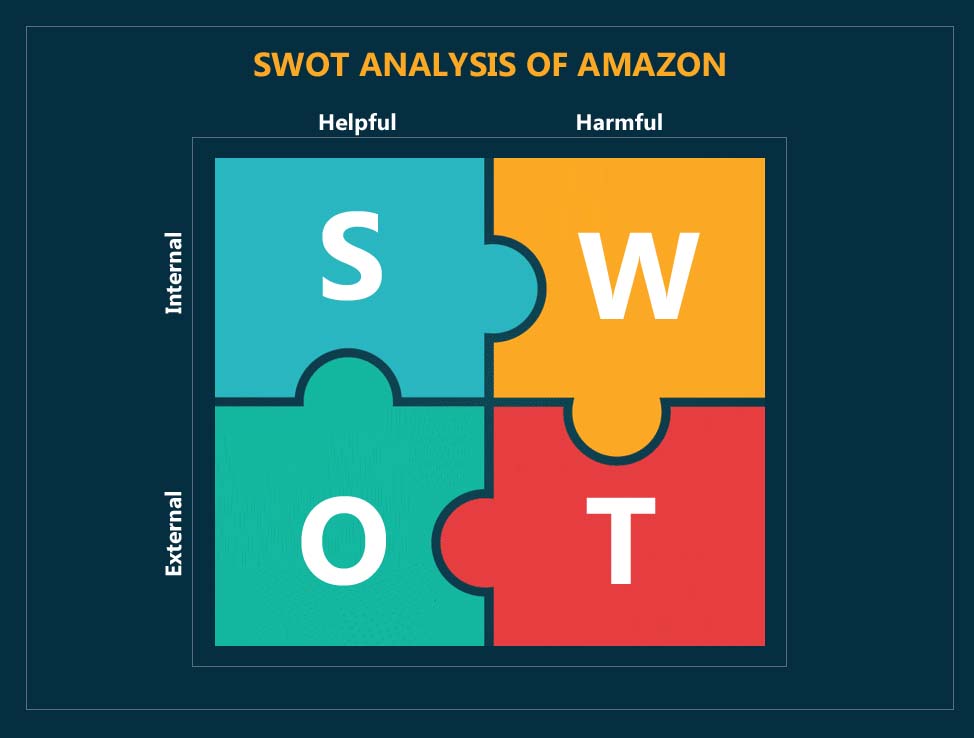
SWOT Analysis of Amazon focuses on Strength, Weakness, Opportunity, and Threats. Strength and Weakness are internal factors and Opportunities and Threats are external factors.

Amazon was one of the first online bookshops and quickly became the world’s largest internet retailer, and now, even though it has a lot of competition, Amazon’s swot research shows us that Amazon has a solid base of loyal buyers who regularly order from online retailers. Here’s the study of the Amazon SWOT.

swot analysis of amazon

Strengths in the SWOT Analysis of Amazon – Amazon SWOT Analysis

  • Strong history and deep pockets – Based on early achievements in books, Amazon now has product lines that include electronics , toys, sports, home and kitchen, white goods, brown goods, and more. Amazon has grown into a multinational e-commerce leader over the past two decades.
  • Customer-centric: a robust CRM firm has developed consumer-centric systems to carefully monitor customer purchasing activity data. This allows them to sell individual objects, linked objects or to package them as a deal on the basis of interests shown by sales or products visited. The company further reports that 55% of its consumers are returning buyers, resulting in a low cost of attracting new buyers.
  • Cost management: In order to distinguish itself, the organisation has formed many strategic partnerships with other businesses to deliver better customer support. Logistics companies that manage prices are the most significant competitive ties. This leads to a solid supply chain. Amazon is in a position to minimise product replenishment time by drawing on economies of scale.
  • Effective fulfillment network: Amazon has built a large and organised distribution network through its strategic partners & with its Amazon fulfilment centres in order to make the product accessible even in remote areas. It also has no expense shipping costs in some geographies.
  • GLOCAL approach: using the “Go Global & Act Local” technique, Amazon is able to compete with domestic e-commerce firms by acquiring & forming / partnering with supply chain companies. Branding, too, is achieved according to the local palate. For eg, Amazon is currently using the “Aur Dikhao” campaign in India to inspire consumers to search more of their items.
  • Acquisitions: Purchasing businesses such as Zappos.com, Junglee.com, IMBD.com, woot.com etc. has proved to be a fruitful and revenue-generating move for the E-Commerce giant.
  • Significant number of third-party vendors – Owing to the heavy traffic rate on Amazon sites, a huge number of third-party vendors have entered the Amazon Marketplace to market their own products. The data from Delivery by Amazon ( FBA) shows that more than 2 billion products are available from third-party vendors.
  • Go National and Behave Local Approach – Amazon has gained the most from this approach. Amazon is forming alliances with local supply chain firms that help it succeed against domestic e-commerce rivals. It recognises local needs and delivers its programmes in accordance with the culture of the region.
  • In India , for example, a consumer initiative called “Aur Dikhao” was launched to inspire consumers to scan more of its products.
  • Effective acquisitions of Entire Foods, Zappos.com, woot.com, Junglee.com, IMBD.com, and several more have driven substantial sales and profits for Amazon.
  • The three key companies involved – Amazon Marketplace, Amazon Web Services (AWS) and Amazon Prime – are three major Amazon companies who operate and support each other. They produce huge revenues and benefits for the company as a whole.
  • Business Leader – With over $1 trillion in market capitalization and over $280 billion in gross sales, Amazon is undoubtedly a global pioneer in online shopping.
swot analysis of amazon - 1

Weaknesses in the SWOT Analysis of Amazon – Amazon SWOT Analysis

  • Shrink margins: due to large distribution network & price wars Amazon’s profits are declining, resulting in losses.
  • Problem of tax evasion: Amazon has received bad attention due to tax avoidance in countries such as the United States and the United Kingdom. Much of the sales comes from these well-established industries.
  • High Debt: In many developed countries, Amazon is also trying to make a company viable, reducing the overall viability of the organisation resulting in high debt.
  • Product Flops – Amazon launched a fire phone in the US that was a major flop. Around the same time, the Kindle fire did not pick up as quickly as the Kindle fire did. As a result, there were some product flops that caused a dent in Amazon’s deep pockets.

Opportunities in the SWOT Analysis of Amazon – Amazon SWOT Analysis

  • Backward integration: Amazon will come up with its in-house products in a range of product categories. They will also distinguish their products. This would help them make money on a highly competitive e-commerce industry.
  • Global growth: growth primarily in Asian and emerging countries would benefit Amazon, since these are areas with low competition in e-commerce and are not crowded as developed economies.
  • Acquisitions: when purchasing e-commerce firms, the amount of competition can be lowered and the technical resources of the other business can also be utilised.
  • Opening retail outlets in the U.S.: by doing so, Amazon will encourage consumers to connect with the company, resulting in increased return sales and increased loyal consumer base.

Threats in the SWOT Analysis of Amazon – Amazon SWOT Analysis

  • Low entry barriers of the industry: Low entry barriers impact the market of the existing player, as more and more businesses mean intense competition, pricing wars, declining profits and losses resulting in challenging the viability of the firms.
  • Government Regulations: the lack of clarification on issues relating to FDI in multi-brand retail has been a significant barrier to the growth of e-commerce companies in many developing countries.
  • Local rivalry – India has snapdeal and Flipkart, which are small e-commerce stores that take away the bulk of the market. Likewise, there are many smaller competitors who take their bites from the market share, making it impossible for a major player like Amazon to make a return.
  • Legal Threats – Amazon is one of three online companies facing the US State Department ‘s investigation of retaining supply chains and labour outlets related to human rights violations. This exposes the e-commerce giant to reputational, economic and legal threats.
  • Can cybercrime may have an effect on the company’s network protection framework.
  • Imitation is easy, since many new competitors typically come up with the same Amazon business model on the market.
  • Fake Products – The rise in fraudulent and counterfeit goods is affecting Amazon ‘s revenues. The corporation also filed a lawsuit against New York-based online retailer for reportedly counterfeiting Valentino bags, Amazon’s premium Italian fashion brand.
  • Economic crisis – Amazon is not safe from global recession. If economic instability worsens, it can have an effect on Amazon revenues.

If you like This Article Please Like our Facebook Page PROJECTS4MBA

Cite This Work

Referencing Style to cite this article:
[citationic]

SWOT Analysis of Amazon [Step by Step SWOT] Read More »

SWOT Analysis of Accenture – Accenture SWOT Analysis [Explained]

SWOT Analysis of Accenture focuses on Strength, Weakness, Opportunity, and Threats. Strength and Weakness are internal factors and Opportunities and Threats are external factors.

Accenture is one of the world’s largest consultancy company, and known for its four best-performing arms. Strategy for Accenture, Accenture Multimedia, Accenture Technologies and Accenture Operations. The business offers consultancy, infrastructure and outsourcing services to executives. Here’s the SWOT review of Accenture.

swot analysis of accenture - 1

Strengths in the SWOT Analysis of Accenture – Accenture SWOT Analysis

  • The world’s largest consultancy company: in terms of sales, it is the world’s largest consulting firm based primarily on IT and business consulting. It has excellent corporate practices & uncompromising high-performance expectations.
  • Strong Partner: it has a wide customer base with some of the biggest corporations including Accenture as their advisors. Almost 90 out of a fortune top 100 firms & more than three quarters of a fortune global 500 companies have Accenture as a consultancy company.
  • Service Delivery Network: Accenture has a global delivery network in more than 200 cities, 56 countries and 390,000 dedicated employees working continuously to ensure good service delivery to end-customers.
  • Client Oriented Processes: Good corporate partnerships & customer-focused strategy Accenture lets them build industry-based, sustainable value for their advisory partners.
  • Continuous improvement: Like Kaizen of Toyota, Accenture is constantly looking to improve its skills, to recruit a stronger and more skilled workforce, while balancing its commitment to end-users.
  • Various capabilities: through its five operational units, including Marketing, Media & Telecommunications, Financial Services , Health & Public Services and Product Expertise, it has established a range of skills within its staff. Dedicated and qualified personnel for each vertical is what makes Accenture distinct from the others.
  • Expertise: With its client base ranging from hospitals and manufacturing to IT services, Accenture has a lot of experience and skill behind it in getting things done. As a result, Accenture has been a “specialist” or “expert” through various sectors.
  • Return on Capital Expenditure: In the past, Accenture was able to effectively produce positive returns on the capital expenditure it spent on different ventures.
  • Automation: has enabled more effective resource utilization and cost reduction from various stages of production. It also enables its goods to be consistent in quality, and offers the flexibility to scale up and scale down production as per market demand.
  • Trained labor force: Accenture has invested heavily in its workforce training, which has resulted in it hiring a significant number of professional and motivated workers.
  • Has a diverse workforce, with people of many ethnic , racial, cultural and educational backgrounds who help the organization bring in various ideas and methodologies to do things.
  • Has trained and certified competent team-workers.
  • Entering new markets: Creative teams from Accenture have helped it to come up with new products and reach new markets. In the past it was successful, in most of the initiatives it took in new markets.
  • Product Portfolio: Accenture has a broad selection of products where it sells products in a wide variety of categories. It has a range of exclusive product deals which competitors don’t have.
swot analysis of accenture
([Logo Above is the Registered Trademark of its Owner – Accenture] Here it is used for Educational Purpose)

Weaknesses in the SWOT Analysis of Accenture – Accenture SWOT Analysis

  • Lack of coordination: Accenture has 19 corporate divisions operating collaboratively with and with customers. This leads to conflict due to a lack of internal coordination.
  • Dependency on its consultancy business: while its company is in management consulting, technology & BPO, the consulting portion is the key source of income for Accenture. This can be costly for the company in the long term, because operating such a massive project allows the business to be ready for poor financial days.

Opportunities in the SWOT Analysis of Accenture – Accenture SWOT Analysis

  • Business expansion: By approaching small and medium-sized enterprises and spreading to other developing economies (Market Development), Accenture will increase its revenue even more.
  • Acquisitions: Accenture recently purchased ‘Gaspo,’ an analytical tool company based in Brazil. It has acquired Agilex technology, a supplier of software & IT services to the U.S. government. It’s departments. Such acquisitions can increase the analytical strength of Accenture, thus allowing it to grow.
  • Relying on other companies: relying more on technologies & BPO, and making sales equal to outsourcing, will allow the company to enter the market much further. This diversification would also offer a cushion through difficult financial times.

Threats in the SWOT Analysis of Accenture – Accenture SWOT Analysis

  • Competition: intense competition from IT giants such as IBM, Capgemeni, Infosys is a matter of concern to the firm.
  • Poor financial times: it was challenging for the company after the crisis due to over-reliability on premium customers. The large companies were the first to have been seriously impacted by the financial crisis. That’s why the sales of Accenture decreased.

If you like This Article Please Like our Facebook Page PROJECTS4MBA

Cite This Work

Referencing Style to cite this article:
[citationic]

SWOT Analysis of Accenture – Accenture SWOT Analysis [Explained] Read More »

SWOT Analysis of GUCCI – SWOT Analysis of GUCCI [Detailed]

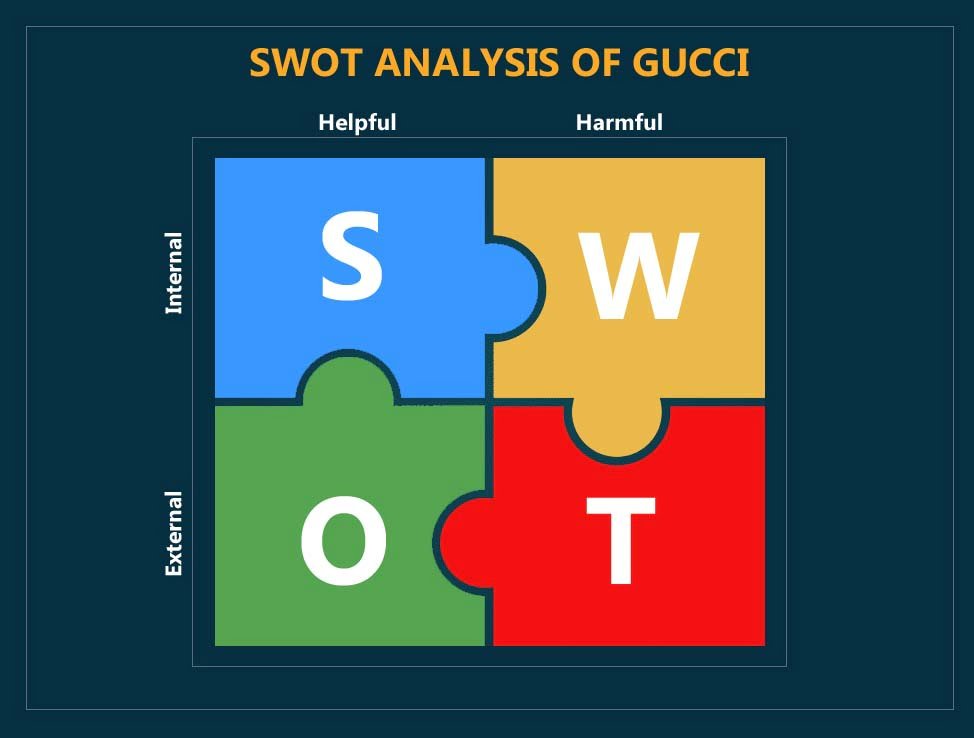
SWOT Analysis of GUCCI focuses on Strength, Weakness, Opportunity, and Threats. Strength and Weakness are internal factors and Opportunities and Threats are external factors.

GUCCI is an Italian brand owned by “Kering” a French group. It was founded in 1921 by GUCCIo GUCCI. It has a very fascinating background in which GUCCIo GUCCI himself was employed in luxury hotels, and looking at the high-value luggage, he decided to create something of his own that was top quality.

Let’s Discuss GUCCI SWOT Analysis – SWOT Analysis of GUCCI

swot analysis of gucci

Strengths in the SWOT Analysis of GUCCI – SWOT Analysis of GUCCI

  • Brand Equity – A fashion brand that sells at high rates needs very strong Brand equity. GUCCI brand was ranked 38th in the entire world by Forbes. The Brand value of GUCCI in 2020 was $17.63 billion.
  • Highest quality products – GUCCI goods are of the highest quality and the most expensive pieces in the market. GUCCI has a good market reputation and Brand Value. In apparel, there are very few companies that can meet the GUCCI standards.
  • Strong international market presence – GUCCI has about 500 stores in several countries. Its main presence is in the UK, the US, Japan and other developing countries.
  • Product range and scope – GUCCI ‘s product collection includes luxury handbags, men’s and women’s accessories, clothes and everything but fashion is a big benefit. It is a complete symbol of ultra luxury lifestyle.
  • Keeps Diversifying – In the fashion industry, it’s not easy and one of GUCCI ‘s advantages is that it doesn’t wait for events to launch something different, but keeps adjusting things so that the architecture of the store still looks fresh and trendy.
  • CSR Initiatives – GUCCI as a company participates in numerous CSR activities. One of them has long been with Unicef and the other is Chime for Progress.
  • Good tie-ups – Being a luxury fashion brand, it was inevitable that the company would also venture on Automobiles. GUCCI has designed several cars over the years giving the car a special combination of performance and fashion.
  • Trained labour: GUCCI has invested heavily in the preparation of its employees, which has resulted in the recruiting of a large number of skilled and inspired workers.
  • It has a diverse workforce, with people of many political , religious, cultural and educational backgrounds who support the organisation bring together different ideas and methodologies to do things.
  • Social Media: GUCCI has a strong social media presence and more than millions of followers on the three most popular social networking platforms : Facebook , Twitter and Instagram. It has a high level of customer engagement and short customer response time on these platforms.
  • Website: GUCCI has a well-functioning and appealing website that draws a massive amount of internet traffic and sales.
  • Brand portfolio: GUCCI has a wide range of products where it offers products in a broad range of categories. It has a number of exclusive commodity offers that rivals do not have.
  • GUCCI has a well-established IT framework that guarantees that its internal and external activities are efficient.
  • GUCCI is a brand that has been on the market for years and which people remember. That makes her very conscious of her brand.
swot analysis of gucci - 1

Weakness in the SWOT Analysis of GUCCI – SWOT Analysis of GUCCI

  • Constant updating is needed – One of the main disadvantages for any brand in the fashion industry is that there is a need for continuous improvement.
  • Commercial nudity – It is a big factor where GUCCI faces flak in its ads. It uses sexuality in Advertisements and shows the female in bad shape because of which it has consistently faced criticism over the years.
  • Trademark infringements and counterfeiting – As the GG mark is popular in its very essence (stands for GUCCIO GUCCI, the founder), it has been counterfeited for many years in many countries. This is one question that GUCCI faces again and again. In addition, there have also been several disputes with GUCCI over trademarks.

Opportunities inside GUCCI ‘s SWOT research

  • Young people are more brand-conscious than ever – today’s youth are practically demanding luxury brands as the earning power is growing and more and more people have a good career.
  • Emerging markets – Emerging markets such as China and India are hot spots for brands such as GUCCI, as demand for ultra premium brands will increase in those markets.
  • Fashion never ends – GUCCI has one huge benefit that fashion never ends. Fashion keeps evolving and someone at the beginning of the line won’t find it difficult to achieve sustainability.

Threat in the SWOT Analysis of GUCCI – GUCCI SWOT Analysis

  • Rivalry – GUCCI’s main challenge is that it isn’t the only lion in the jungle today, like any other market. There are some that are as big as GUCCI, if not larger. Christian Dior, Ralph Lauren, and Burberry are some of the brands that have been a thorn on GUCCI ‘s side repeatedly.
  • Any change in Government Laws and Regulations can directly or indirectly affect the brand sales and brand value of the company.
  • Competitors can launch similar products thus local and international brands are the major threats for the company.

If you like This Article Please Like our Facebook Page PROJECTS4MBA

Cite This Work

Referencing Style to cite this article:
[citationic]

SWOT Analysis of GUCCI – SWOT Analysis of GUCCI [Detailed] Read More »

SWOT Analysis of Hyundai – Hyundai SWOT Analysis [Explained]

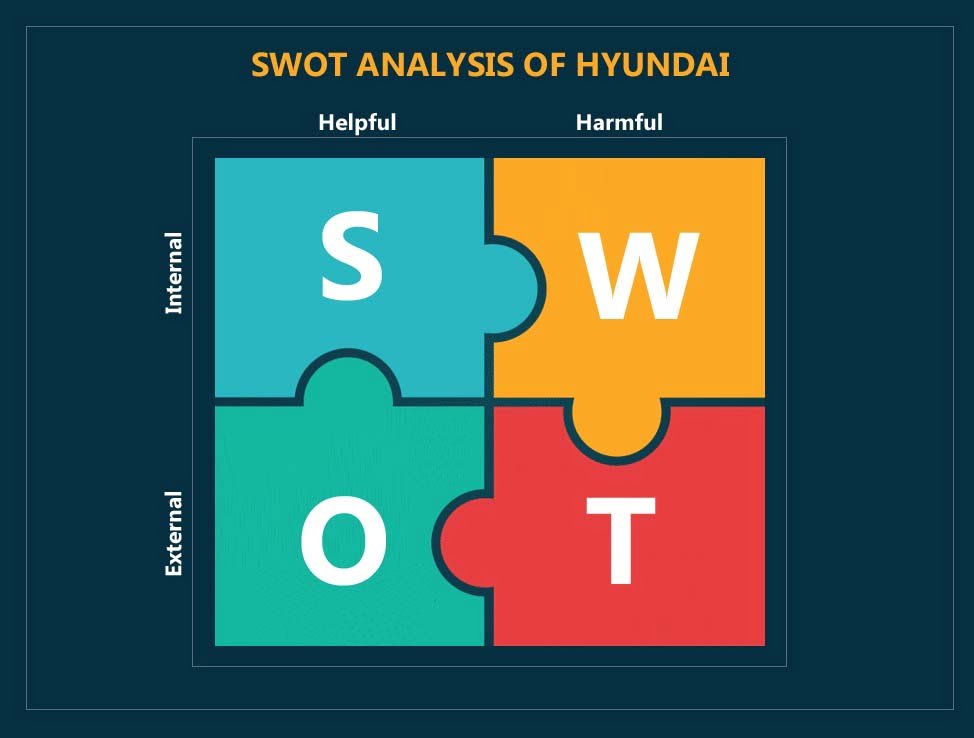
SWOT Analysis of Hyundai focuses on Strength, Weakness, Opportunities and Threats. Strength and Weakness are the internal factors and Opportunities and Threats are external factors.

swot analysis of hyundai

Hyundai is a South Korean Company. Hyundai is the largest car manufacturer and ranked among world’s top five largest automotive companies.

Hyundai means modernity.’ The slogan, “New Thinking New Possibilities” perfectly fits this Brand Name of Hyundai.

swot analysis of hyundai - 1

There is a slanted letter “H” in Hyundai automobiles that symbolises two people shaking hands: the representative of a corporation and a happy customer. This reflects both company and customer trust and satisfaction. The oval around the letter ‘H’ exemplifies the goal of making such deals worldwide.

The company Hyundai was founded in The Year 1967 by Chung Ju-Yung

On 29 December 1967, Hyundai Group started out as a construction firm. Twenty years later its Hyundai Motor Company automotive arm was established. It used to be one of the subsidiaries of Hyundai Group but now the car manufacturer is no longer affiliated with the former conglomerate.

The First Automobile Company to Provide a 10-year Warranty

Hyundai is offering 10/100,000-mile warranty. No automaker has ever before offered such extensive coverage up to this point.

Strengths in the SWOT Analysis of Hyundai – Hyundai SWOT Analysis

  • Hyundai India has such a brand reputation that it is almost believed to be an Indian brand, with many positive accolades for becoming India’s second-most-selling market share brand next to MUL
  • Hyundai Motor India Limited is Asia’s largest automotive exporter, which showed a 10 percent rise compared to the previous FY
  • Domestic sales are that by 19.1 per cent on average
  • HMIL is known for its better-performing quality goods and has consistently advanced in many parameters in the race with Maruti Udyog limited
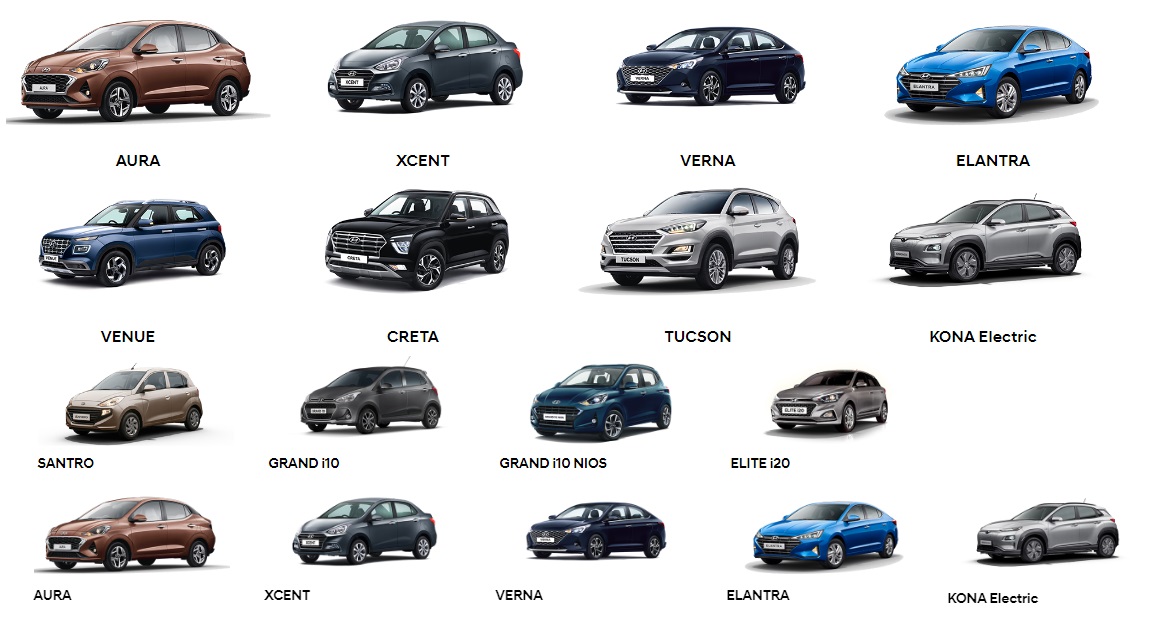
  • The model length comprises around 8 vehicles, beginning with the new Eon in the small car segment to the SUV segment Santa Fe
  • Only HMIL is known among automobile players for its CSR activities
  • Since its operations in India, Hyundai products never fail to win laurels from different automotive ratings in each segment
  • Hyundai, has the largest showroom and service station network in India, next to Maruti
  • Distribution and Reach: Hyundai has a large number of dealers in almost every state, backed by a powerful distribution network ensuring that its products are readily accessible to a large number of customers in a timely manner.
  • Cost structure: Hyundai’s low-cost structure helps it to produce at low cost and sell its products at low cost, making it affordable to its consumers.
  • Automation: has allowed more productive use of the resource and cost savings from different production stages. It also allows its products to be consistent in quality, and provides the flexibility to scale up and down production according to market demand.
  • Skilled labour force: Hyundai has aggressively invested in its workforce training, which has resulted in it recruiting a large number of motivated and skilled employees.
  • Has a diverse workforce, with people of many national , racial, cultural and educational backgrounds that help the company bring in different ideas and approaches to do stuff.
  • Has trained and certified committed team-workers.
  • Entering new markets: Hyundai’s creative teams helped it come up with innovative products and enter new markets. It was popular in the past, it took on most of the initiatives on new markets.
  • Social Media: On the three most popular social networking sites, Hyundai has a strong social media presence with over millions of followers: Facebook, Twitter , and Instagram. It has a high level of customer engagement on those platforms, with low customer response time.
  • Website: Hyundai has a well-functioning and entertaining website that receives a massive amount of internet traffic and sales.
  • Product Portfolio: Hyundai has a large product line where it offers products in a wide range of categories. It has a number of exclusive product offers that rivals have not.
  • Hyundai has a well-established IT system which ensures the success of both its internal and external operations.
swot analysis of hyundai

Hyundai Cars

Weaknesses in the SWOT Analysis of Hyundai – Hyundai SWOT Analysis

  • HMIL has taken a long time to gain market share, as it is not India’s first mover
  • Maruti is stronger on the Indian subcontinent in terms of the most popular and trusted brand;
  • Hyundai vehicle spare parts are comparatively higher cost, and PAN India does not have spare parts
  • Tucson and its next Santa Fe model did not make a significant impact in the SUV segment
  • Margins have been impacted by the rise in product prices such as steel , aluminium and auxiliary parts
  • Since HMIL focuses on domestic and foreign sales, the risk of currency fluctuations is higher
  • Since Hyundai primarily focuses on quality, the majority of its products in each segment are in premium category. Hyundai, like other manufacturers, still struggles to make a better impact in the small car segment in terms of cost efficiency
  • Hyundai has no model match for corporate orders such as Tata Indica V2, Tata Sumo, Tata Indigo, Chevy Tavera, Ford Fiesta etc. These vehicles are favoured for bulk orders in both cab segment and government bookings

Opportunities in the SWOT Analysis of Hyundai – Hyundai SWOT Analysis

  • SIAM – Indian car manufacturers’ company has announced that car sales are steadily growing, both domestic and Indian, contributing a valuable share of India’s GDP.
  • The rate of growth in export markets is 22.30 per cent compared to the previous fiscal year
  • India ‘s saving consumption trend represents an added benefit for every market segment in India. This was one of the key reasons for survival in the Indian market in the global recession
  • HMIL has more space to join the small car segment as its R&D plant in Hyderabad, India has been dedicated. Hyundai is one of the few companies with the world’s largest R&D network in Korea, Europe, India , the United States, Japan
  • Hyundai has a very good opportunity to enter commercial vehicles and recreational vehicles because outside India they are already doing well. HMIL is currently focused solely on the passenger car segment.
  • Big and Luxury Car Segment is the biggest opportunity for the company.
  • Company can focus on small car segments to earn more.

Threats in the SWOT Analysis of Hyundai – Hyundai SWOT Analysis

  • While Hyundai claims to have no other direct competitors than MUL, there are Indian players such as Tata, Mahindra posing a major threat to Hyundai Motors India to broaden its product category
  • Foreign direct investment pouring into Indian automotive space is not good signs for giants like MUL and Hyundai who already exist.
  • Nearly all major car players have begun entering India to open up their market and their manufacturing plant in India. “Chennai “is referred to as Asia’s Detroit!
  • Owing to intense competition from Ford’s Figo and Volkswagen- Polo, Hyundai suffered a small decline in market share
  • Many manufacturers have begun to focus on the small car market as an alternative to Nano. This would decelerate Hyundai’s planned revenue.
  • Change in the Government Norms for Manufacturing of Automobiles directly effect the production of Hyundai Cars.

If you like This Article Please Like our Facebook Page PROJECTS4MBA

Cite This Work

Referencing Style to cite this article:
[citationic]
SWOT Analysis of Hyundai – Hyundai SWOT Analysis [Explained] Read More »

SWOT Analysis of Dabur [Detailed]

SWOT Analysis of Dabur focuses on Strength, Weakness, Opportunities and Threats. Strength and Weakness are the internal factors and Opportunities and Threats are external factors.

swot analysis of dabur

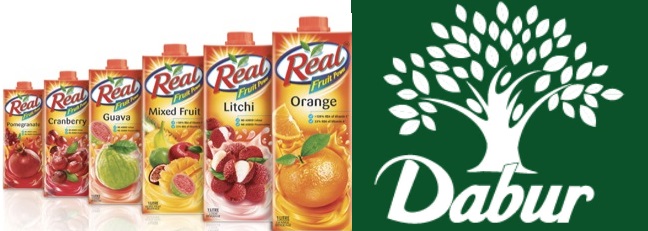
Dabur is India’s Largest Ayurvedic Medicine Company. Dr. S.K. Burman is the founder of Dabur. Dabur, which was originally an Ayurvedic pharmaceutical company, started with the launch of the Dabur Real Juices into the fruit-based drinks market. Indian brands did not have a very strong presence on the fruit drinks market that was largely dominated by multinationals such as Tropicana.

Dabur is also manufacturing Real and Real Activ fruit juices that are available in 16 different flavours such as Mosambi, Mango, Plum, Guava, Litchi, Tomato, Pomegranate, Peach, Cranberry, Blackcurrant,Grape and Apricot.

swot analysis of dabur - 1

The most popular flavours are Raspberry, Mango, Apple & Mixed Fruit. They also have the Real Activ range, which is concentrate based on sugar free fruit. Dabur is more popular for its chawanprash.

Strengths in the SWOT Analysis of Dabur – Dabur SWOT Analysis

  • The fruit juice is available as Real and Real Activ. Both drinks are available in 16 different flavours such as Mosambi, Mango, Plum, Guava, Litchi, Tomato, Pomegranate, Peach, Cranberry, Blackcurrant,Grape and Apricot.
  • Real Fruit: The juice’s unique selling proposition is that there are no additives, and that it is made of organic fruit that is then combined with an equivalent amount of water. There are no sugars or spices included in Actual Game, and no preservatives or additives of any type.
  • Endorsements and certifications: PFNDAI — Protein Foods & Nutrition Development Association of India endorses Dabur Real Juices for its nutritional quality. The juice in the food & drinks category is also the Reader’s Digest Valued Brand Gold Award 2009.
  • Better understanding of the Indian market: In comparison to global brands such as Pepsi, Coca-Cola or Tropicana, Dabur is an Indian business with a deeper understanding of Indian tastes. They introduced Indian fruits such as Mosambi and Guava that are favourites among local audiences.
  • Juice composition: Juices contain no artificial additives, and are high in vitamins and antioxidants. Even the Real Activ which has no added sugars is rich in fiber and can be eaten even by patients with diabetes. The company also offers organic juices and a fruit blend.
  • Dabur India is the fourth largest FMCG firm with US$ 910 million in revenue
  • Dabur has its own history, it is over 100 years old, it was founded in 1884.
  • It is present in approximately 60 countries worldwide
  • It is the world’s biggest supplier of Ayurvedic medicine
  • Dabur has the largest distributors, about 5000 in its respective segment
  • The top five master brands to perform are Dabur, Vatika, Hajmola, Actual, Fem
  • It has 17 advanced manufacturing facilities
  • The length of the prescription involves about 300 approved items and few are sold over the counter
  • Categories of Dabur products include health care, personal care , food, home care, consumer health-OTC / ethical, skilled
  • Distribution and Reach: In almost every state, Dabur has a large number of dealers, backed by a strong distribution network that ensures that its goods are readily accessible to a large number of consumers in a timely way.
  • Cost structure: The low-cost structure of Dabur allows it to manufacture at a low cost and to sell its goods at a low price, making it affordable to its customers.
  • Dealer Community: Dabur has a good partnership with its dealers which not only supplies them but also focuses on promoting the products and training of the company.
  • Financial position: Dabur has a solid financial position with consecutive earnings over the last 5 years, along with accumulated income reserves that can be used to fund potential capital spending.
  • Has a broad asset base offering greater solvency.
  • Dabur has invested heavily in its workforce training, which has resulted in it hiring a significant number of professional and motivated workers.
  • Has a diverse workforce, with people of many ethnic , racial, cultural and educational backgrounds who help the organization bring in various ideas and methodologies to do things.
  • Has trained and certified competent teamworkers.
  • Entering new markets: Creative teams from Dabur have helped it to come up with new products and reach new markets. In the past it was successful, in most of the initiatives it took in new markets.
  • Social Media: Dabur has a strong social media presence with over millions of followers on the three most prominent social networking platforms : Facebook , Twitter and Instagram. It has a high degree of customer engagement with low customer response time on those channels.
  • Website: Dabur has a well-functioning and engaging website that attracts a huge amount of traffic and sales on the internet.
  • Product Portfolio: Dabur has a broad selection of products where it sells products in a wide variety of categories. It has a range of exclusive product deals which competitors don’t have.
  • Dabur ‘s geography and location give it a cost advantage in servicing its customers as compared with the competition.
  • Dabur has a well-established IT system which ensures its internal and external operations are successful.
  • Dabur has many intellectual property rights including trademarks and patents. This require exclusivity of their products and rivals are unable to copy or reverse engineer it.
  • Dabur is a company that has been on the market for years and that people recognise. That makes it highly aware of its brand.
  • Over the years, its goods have retained consistency and are still respected by consumers, who regard it as good value for the price they spend.
  • Relationships: Dabur develops strategic partnerships with its manufacturers , distributors, retailers and other interested parties. This helps it to use them in the future if need be.

Weaknesses in the SWOT Analysis of Dabur – Dabur SWOT Analysis

  • Image: Dabur has always been associated with the pharmaceutical and medical industries, making it difficult for them to take up the picture of a business selling fruit juice compared to their rivals such as Tropicana or Coca-Cola, who had established their presence on the juice market.
  • Indian customs: The Indian customs are very different from the Western world where fruit juice is drunk during breakfast. Fruit juice here is something given to tourists, or rarely drank. That reduced purchase frequency.
  • Packaging: Real Fruit Juices have no chemicals or preservatives and thus the business has had to invest extensively in evaluating packaging technology to maintain the freshness and consistency of their beverages. The short shelf life often poses problems in the management of distribution networks.
  • Cost: Real Fruit Juice is expensive compared to aerated beverages such as Pepsi or Coca-Cola, and thus may not be preferred by all consumers. Another problem here is that such drinks aren’t viewed as choices for value for money.
  • Acquired Taste: Dabur Real Juices has no fresh juice flavor, and is claimed to have a medicinal flavour. Customers may need to get used to the juice ‘s taste to start enjoying the flavor making it a taste they’ve acquired.
  • Dabur has no direct channels to the business
  • The lack of consumer knowledge of the goods
  • Doctors prescribe allopathy medicines because they earn more benefits from medical firms and the proportion of ayurvedic firms is smaller than allopathy.
  • According to a survey , the number of licensed practitioners of Ayurveda is less than 3.7, a negligible amount compared to doctors of allopathy.
  • Ayurvedic medicine needs time to heal compared to treatment with allopathy
  • Research and Development: While Dabur is investing more than the industry’s average expenditure on research and development, it is investing much less than a few market leaders who have had a major advantage as a result of their revolutionary goods.
  • High Day Sales Inventory: The time it takes to buy and sell goods is higher than the industry average, which ensures that inventory builds up adding additional costs to the company.
  • Integration: The existing structure and culture of Dabur has resulted in the failure of numerous mergers that seek to integrate vertically.
  • Workforce diversification: Dabur ‘s workforce is concentrated mainly with white employees, with small numbers of staff from other ethnic backgrounds. Lack of diversification makes transition at the workplace challenging for workers from various ethnic backgrounds, leading to a loss of talent.

Opportunities in the SWOT Analysis of Dabur – Dabur SWOT Analysis

  • High market potential for packaged drinks in India: the packaged drinks industry has a market size of about 100 crores of INR and is projected to rise at about 18 percent per year. For an Indian business like Dabur this is a big opportunity.
  • Favourable climate in India: Domestic businesses have a lot to gain in terms of government funding with the government promoting “Make in India” In addition, the food processing industry is given several concessions.
  • Dabur is the largest Ayurvedic medicine in the world and its export volumes are constantly in demand in the foreign market
  • Yoga and Hindu association is proving more beneficial to the global penetration of ayurvedic medicines
  • People have begun to understand that Ayurvedic medicines such as Dabur, Himalayas etc have no side effect
  • Growing earning power for women has made them independent and made them more health-conscious and attractive – a segment in which Dabur also seeks to capitalize on its products
  • Improper and unhealthy eating habits due to modernization forced people to take supplementary Ayurvedic medicines such as Chavanaprash, Hajmola and Life Style medicines
  • In the last 2–3 years, Ayurveda as a area has gained much more attention all over the world. So Dabur has an immense opportunity to capitalize on investor sentiments.
  • Internet: The number of internet users around the world has been growing. That means there’s an opportunity to broaden their online presence; using the internet to connect with their customers.
  • E-commerce: The e-commerce industry has undergone a new phenomenon and a increase in revenue. That means a lot of people are making online transactions now. Dabur can gain money by opening and making purchases through these online stores.
  • Social networking: The number of social media users worldwide has grown. The three social media platforms ; Facebook , Twitter, and Instagram have recorded the highest number of monthly active user rises. Dabur may use social media to advertise its goods, communicate with clients and gather feedback.

Threats in the SWOT Analysis of Dabur – Dabur SWOT Analysis

  • Low entry barriers: There are minimal to no entry barriers in the fruit drinks market and there is competition in all forms and shapes. Even small to medium-sized enterprises are setting up local production units which make fruit juices.
  • Competition: Minute Maid, Onjus, Coca-Cola, Pepsi, Mirinda, Slice, Maaza, Frooti, and Tropicana are among Dabur Real’s main competitors.
  • Companies Producing Ayurvedic Medicines and Allopathic medicines are the major threats to Dabur.
  • Some ayurvedic doctors offer their own medicines or offer a mix of the medication without packaging (loose medicines) from the Ayurvedic Business. This decreases retail sales and diluts the brand image
  • Since traditional practice of ayurvedic medicine is obtained, there are many untrained professions that take up the profession
  • Many Ayurvedic medicines contain more lead and ferric material, which can often lead to reverse side effects when taken for a longer period of time.
  • For most treatments Kerala is an Ayurvedic centre. That’s why people visit health camps directly to get cured.

If you like This Article Please Like our Facebook Page PROJECTS4MBA

Cite This Work

Referencing Style to cite this article:
[citationic]

SWOT Analysis of Dabur [Detailed] Read More »